 economic
(incl. physical),
social and ecological
aspects
economic
(incl. physical),
social and ecological
aspects|
|
FH Stralsund
- Leisure and Tourism Management
|
|
|
You are on www.arlt-lectures.com |
Best viewed with Internet Explorer |
|
TI |
Tourism Impact |
|
"Tourism Impacts" will deal with the results of the development of tourism as a mass phenomenon in the last century.
How is tourism changing the world in social, economic and last but not least ecological ways?
Tourism takes place in physical surroundings, but is an important part of reality production in post-modern societies.
Today it can be said that tourism creates the world according to it's needs.
To understand this better let's briefly compare the development of the last century, i.e. the development from industrial to post-industrial (or modern to post-modern) world and elite tourism to mass tourism, looking at the three components of "Sustainability":
economic
(incl. physical),
social and ecological
aspects
Sustainability in Leisure and Tourism
The 20th century has seen remarkable advances in the development of science and technology and in social productivity. The abundant material wealth created by mankind is unprecedented and it has resulted in a rapid development of civilization.
However, aggravations caused by population expansion, excessive consumption of resources and global environmental problems such as pollution, reduced biodiversity and increased gap between north and south, have seriously hampered the development of economies and improvements in people's quality of life, and are even threatening human existence itself.
Given the pressures of these harsh realities, mankind has no choice but to re-examine its social and economic behavior and its path of development. Traditional ideas of considering economic growth solely in quantitative terms and the traditional development mode of "polluting first and treating later" are no longer appropriate when considering present and future requirements for development.
It is now necessary to find a path for development, wherein considerations of population, economy, society, natural resources, and the environment are coordinated as a whole, so that a path for non-threatening sustainable development can be found which will meet current needs without compromising the ability of future generations to meet their needs.
Sustainability - What does it mean?
sus·tain·abil·i·ty
[s&s-'stA-n&-'bi-l&-tE] noun |
Careful! Differences in different languages: f.i. Nachhaltigkeit, Durabilité, Naiyong
Nachhaltigkeit:
|
|
Der Begriff der Nachhaltigkeit stammt ursprünglich aus der Forstwirtschaft
und wurde erstmals um ca. 1700 vom Oberberghauptmann Hans Carl von
Carlowitz in der Silberstadt Freiberg (Sachsen) "erfunden". Auch hier war
der neue Begriff der Nachhaltigkeit ein Kind der Krise: nicht etwa die
Erschöpfung der Silberlager- stätten sondern die sich schnell verschärfende
Holzknappheit veranlasste den adeligen Forstmann zur Erarbeitung eines
Nachhaltigkeitskonzepts zur dauerhaften Bereitstellung ausreichender Holzmengen
für den Silberbergbau. Nachhaltigkeit in der Forstwirtschaft
bezeichnet eine Art und Weise der Holzwirtschaft, bei der der Waldbestand als
natürliche Ressource für die Holzwirtschaft auf Dauer gesichert bleibt. So wird z.B. immer nur soviel Holz geschlagen, wie durch
Wiederaufforstung nachwachsen kann. Ulrich Grober: "Der Erfinder der Nachhaltigkeit. http://www.learn-line.nrw.de/angebote/agenda21/archiv/99/pr/zei4898nachhalt.htm |
Definitions:
Standard Definition:Brundtland Report (World Commission on
Environment & Development)
Sustainable development is development that meets the needs
of the present without compromising the ability of future generations to meet
their own needs.
US President's Council on Sustainable
Development:
"Sustainable
development is economic growth that will benefit present and future
generations without detrimentally affecting the resources or biological systems
of the planet. A sustainable United
States will have a growing economy that provides equitable opportunities
for satisfying livelihoods and a safe, healthy, high quality of life for current
and future generations. Our nation will protect its environment, its natural
resource base, and the functions and viability of natural systems on which all
life depends."
David Schaller (Sustainable
Development Coordinator for the Denver Regional Office
of the U.S. Environmental Protection Agency)
Achieving the ecological balance which allows
economic prosperity and social equity to be achieved across generations.
Muscoe Martin, Author
of: "A
Sustainable Community Profile
The word sustainable has roots in the Latin subtenir, meaning 'to hold up' or
'to support from below.' A community must be supported from below - by its
inhabitants, present and future. Certain places, through the peculiar
combination of physical, cultural, and, perhaps, spiritual characteristics,
inspire people to care for their community. Theses are the places where
sustainability has the best chance of taking hold.
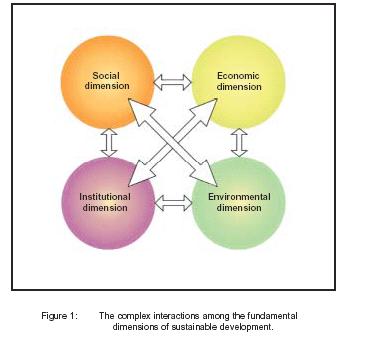
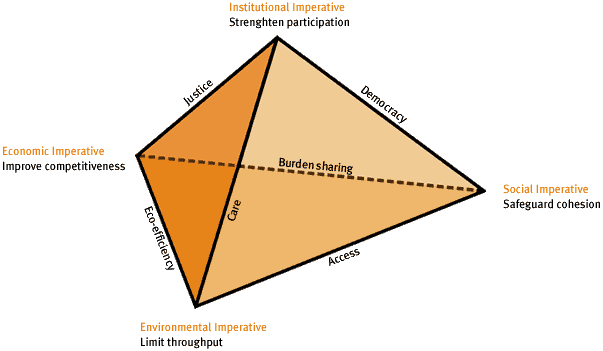
The three dimensions of Sustainability:
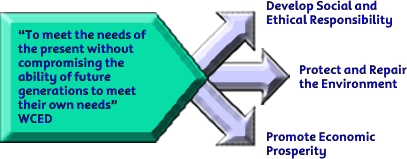
"3 P": Planet, People, Profit
A fourth dimension: Institutions
Sustainability in L&T - economical
Statement by BASF company (http://www.basf.de/en/corporate/sustainability/oekonomie/):
"What is meant by the economic dimension of sustainability? The goal of business activities (in a market economy, WA) is to generate high profits by making optimal use of resources, to ensure long-term competitive success and to increase corporate value. The principle of sustainability has the goal of balancing the economic, environmental and social needs of todays society without impairing the development opportunities of future generations. In many ways, the two goals support one another."
Statement by World Business Council on Sustainable Development (http://www.wbcsd.ch):LET'S DISCUSS THIS TWO STATEMENTS!
Tourism industry is much more interested in the protection of environment and heritage than other industries.
Why is it more important from an economical point of view for a destination to care about this questions then let's say for an automobile manufacturer?
Economic sustainability in L&T also has an important Human Resource Management aspect.
What is the impact of the concept of economic sustainability on HRM?
Sustainability in Leisure and Tourism - ecological dimension
The three dimensions of Sustainability:
http://www.hawaiitourismstudy.com/
Leisure and Tourism creating environmental problems
Overview (Dot = area where tourism is creating problems, arrow upward = level of problems increasing)
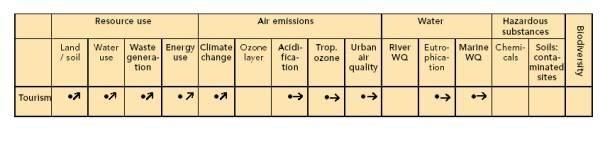
From: http://themes.eea.eu.int/Sectors_and_activities/tourism/indicators/signal01_chap4.pdf
For instance:
Direct influences:
Leisure and Tourism activities taking place in areas which otherwise would not be touched by man (high mountains, coral reefs, caves, remote islands), making building of roads necessary, pollute the area, bring waste problems etc..
Leisure and Tourism activities destroy ecosystems by overuse (2nd homes in Europe, Himalaja etc.)
Leisure and Tourism activities cost much more energy and water than staying at home / use of locals through watering of golf courses etc., swimming-pool, air-condition etc.
Indirect influences:
Travelling increases pollution from cars, planes etc.
Energy usages and pollution increases effect on atmosphere etc.
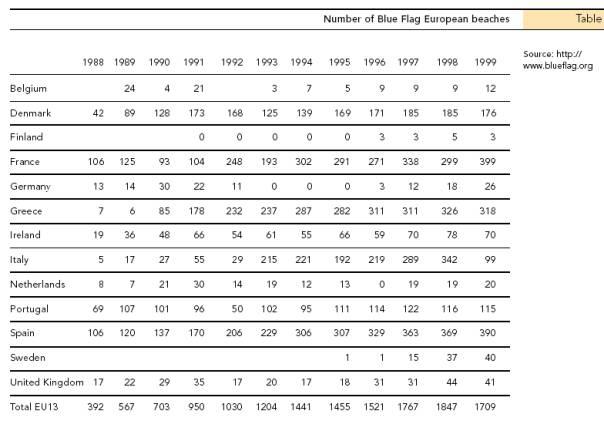
Leisure and Tourism solving environmental problems
As the tourism industry is itself interested to keep the environment from deterioration, it is defending itself by showing the positive effects of tourism, f.i. in the cleaning of water pollution in the mediterranean sea:
Four different option for ecological policies supporting sustainable tourism:
 Information about eco-damages and appeals to the
eco-consciousness
Information about eco-damages and appeals to the
eco-consciousness
Tax reductions and financial support of eco-friendly
behavior
Direct government intervention (building water treatment
systems, buying from eco-friendly producers etc.)
Eco-laws and -rules (Emission level ceilings, Protected
Areas etc.) and Sanctions for violation of laws
and rules
|
Which of these policies do you regard as most successful?
|
|
Is sustainable tourism just a marketing tool to hide the negative effects of global tourism or a real chance?
One half of the group is supporting the first view, the second half the other view. Please discuss!
|
|
Contact: wolfgang.arlt@fh-stralsund.de,
Office: Hs.
1 / Rm. 132, |
 |
