|
|
Qualitative differences in tourism
behaviour: Example
Japan
|
|
|
1. Nation-building ‘Ambitious Japan’, as it calls itself in English
on the new Shinkansen 700 trains, today appears as an insular,
industrial society stranded in a globalised postindustrial world,
trying to retain (mainly imagined) pre-industrial values. Whereas
many societies are in a process of changing from "World as a
theater" to "World as a workshop", the japanese society sticks
to bolted-on masks.
‘Inventing Japan’ (Buruma 2003) after 1853 meant
the double and contradictory task of ’restoring’ the rule of
the Emperor, the Shinto religion and ‘national’ pride through
attempts of catching up with 'modernity' to become a leading
member of modern nations.
Three major
attempts to achieve this failed in 1921, 1945 and 1990.
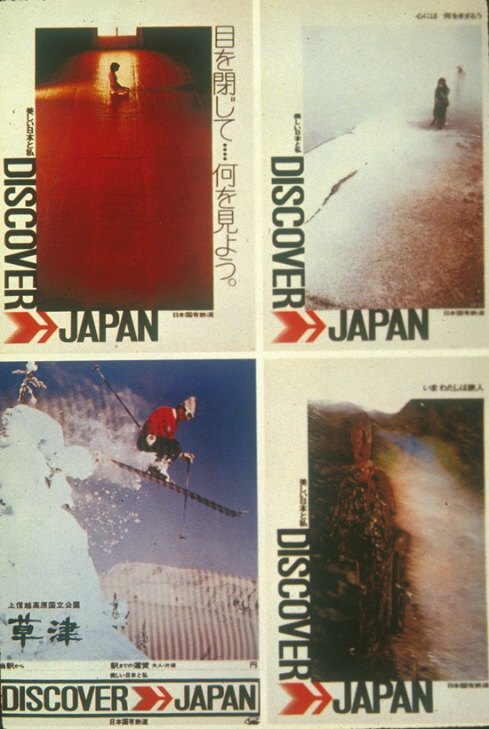
In the development of Japanese domestic tourism
this is reflected in the successful decade-long marketing campaigns
of “Discover Japan” in the 1970s and “Exotic Japan” in the 1980s.
‘Discover’, starting after the EXPO in Osaka,
appealed to young (mainly female) Japanese not to visit
meishos (noted places) but rather to find the spirit of
the ‘old’ Japan in encounters with it and therefore to find
themselves.
“Although this Japan was billed as native and
original, it was a Japan in many ways unknown to its young urban
travellers. .. Japan beckoned as something strangely familiar: the
native remote.” (Ivy 1995, 47)
‘Exotic’ took the nostalgic longing one step
further: Stylish and arty in appearance, it enticed to travel within
Japan not to rediscover ‘old’ Japan, but the nostalgia
for it, the lost feeling of the feeling of loss.
Furusato (old hometown) tourism is another important part
of domestic tourism of inventing the nation and
"reconstructing selected images of the Japanese
people’s traditional way of life." (Moon 1997, 185)
2. Leisure and Tourism in
the
Japanese society
|
“The family holiday is not unknown, ..
but in general such trips tend to be much shorter than .. in
Europe. Two nights away is perhaps typical, and the father of
the family will be itchy to get back to work.” (Hendry 1987,
165) |
Long absence from work by making full use of
granted paid holiday is still frowned upon. Unlike western positive
images of otium as 'recharging the battery' and ‘getting new
ideas’, i.e. self-actualisation through leisure, leisure activities
and the necessary absence connected to it are seen as ‘letting down
the collegues’, only partly redeemed by buying omiyage
(souvenirs) for the left-behind.
“A feeling of guilt in seeking mere pleasure dies
hard within a culture of hard work. .. And this axiom is fortified
by people’s concern for, and attention to, others in close
proximity, such as family, relatives, neighbours, and fellow
workers.” (Kajiwara 1997, 169)
Paid
holidays are granted to employees (app. 20 days/year). It is however
socially impossible to use the full
amout.
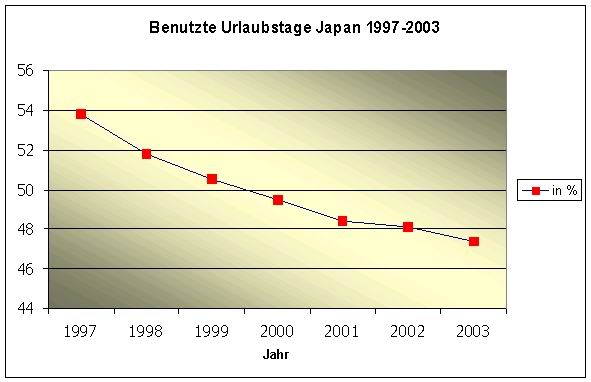
© Arlt 2005 after (TIJ
2004)
A report from 2008: According to a survey
conducted in Japan as well as in eight countries in Europe and North America, the Japanese only took an annual average of eight paid holidays — smaller than any other country questioned. France topped the list with 34 days, followed by Italy and Spain with 27 paid days off annually.
Among the reasons why Japanese employees can’t take paid holidays
were, “Too busy with work” and “Their bosses and colleagues have yet to
take their paid leave,” the survey found.
Japanese travel less
and much shorter than the inhabitants of other OECD countries,
travel motive is often an event: 3,9 nights p.P. p.y., compared to
17,1 (Germany) and 16 (France, GB). Japanese overnight stays per
year decreased year-by-year since 1991 (OECD 2002).
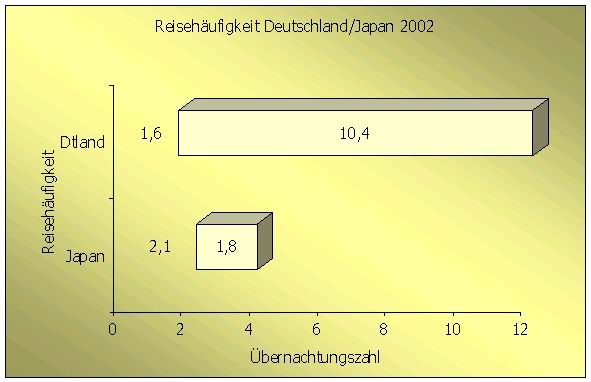
© Arlt 2005 after (TIJ
2004)
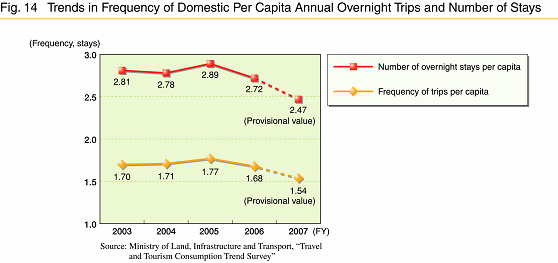
App. 13% of the Japanese travel across the border
once a year.
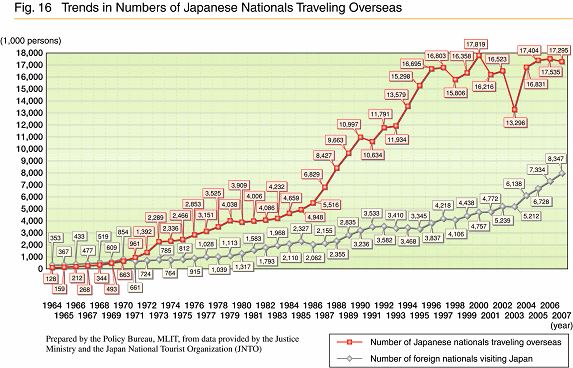
© Whitebook
on Japans Tourism 2008 |