|
|
Qualitative differences in tourism
behaviour: Example
Japan
|
|
|
Tourism in Japan today
Tourism delivers only app. 2% of GDP (2,2%
in 2000, 1,9% in 2003) and less then 3% of jobs (2,9% 2000,
2,7% 2003) (OECD 2002, TIJ 2004). The average for OECD countries in
both respects is 4-5%.
Inbound tourism amounts to app. 8 mio. visitors
per year only, less than Singapore, and less than half the
global average in the ratio of arrivals/population.
95% of overall revenues of the Japanese tourism
industry stem from domestic tourism (TIJ 2004).
The “Yokosa Japan” (Welcome to
Japan) campaign increasing the number of visitors from 5.3 mio.
in 2003 to 8.3 mio. in 2008, but in 2009 it fell back to 6.8 mio., for 2010 a maximum of 8 mio. visitors can be expected, a long way from the aim of bringing 10 mio. visitors to
Japan by the year 2010. Japan will continue not to be among the 25 major tourist
destinations.

2010: "Japan. Endless Discovery." is a new slogan that refers to "Japan—a
country offering inexhaustible delights". This slogan expresses our hope
that foreign visitors will come to Japan many times and gain a deep
understanding of the various tourism resources in Japan. Each visit is
an opportunity for travelers to encounter the rich nature of Japan as
represented by cherry blossoms, the history and traditional culture of
Japan, and the modern culture, cuisine and everyday life of Japan's
people.
Taking into account the four factors mentioned
before, these results are not surprising:
 Domestic
tourism is an exercise in definition of
'Japanese-ness'. Domestic
tourism is an exercise in definition of
'Japanese-ness'.
Furusato tourism is not for foreigners, just the
opposite, as even trips to ’Peter Rabbit Country’ and ‘Heidiland’
become visits to “A furosato away from home”
(Rea 2000).
The
guilt-ridden briefness of absense from home leads to short-term,
event-orientated travels with onsen (hot springs) as
the major non-temporary attraction. This is also reflected in the
hardware: hotels with no wardrobes, airport transit busses without
luggage departments.
The
overarching influence of construction companies in tourism resort
development is reflected in the concentration on big projects
designed for visitors arriving in big groups and in the limited
concern on giving reasons for return-visits; a form of tourism in
decline since the end of the bubble economy.
The
event-orientation expands from cultural festivals also to en-masse
visits to specific nature resources on specific occasions (blossoms,
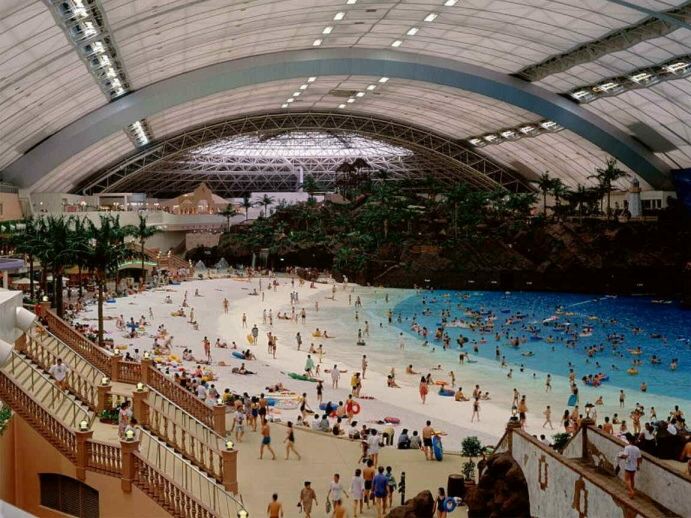
coloured leaves, heatwave etc.). The preference of man-made nature
makes understandable the construction of huge artificial beaches
within view of the ocean like the famous Ocean Dome in
Miyazaki/Kyushu.
The Acquisition and consumption of spatial and
cultural resources by tourism is comparatively limited in Japan.
As a positive result of its weekness, tourism in
Japan has not succeeded in forcefully opening up the inside of
sacred places like Shinto shrines to the tourist gaze. In the
cities, however, the same weekness results in demolition of profane
historic buildings, the filling-up of canals, the blocking of vistas
as part of landscaped gardens etc.
Local rural cultures – idealised,
commodified – are nourished.

Shirakawa-go UNESCO World Heritage Site
|