|
Basic Fact 1: Nobody knows how many tourists have been travelling.
Accepted definition but shaky statistics for cross-border tourism
Diverse definitions and different statistical approaches for domestic tourism
Fuzzy information for day-trippers
Basic Fact 2: Tourism is not an "industry" in the sense of the the System of National Accounts (SNA), therefore a way has to be found to define what parts of production and consumption should be included or not included.
Solution:
TSA Tourism Satellite Accounts:
Download: BG-TSA.pdf
1.1. Tourism as a demand side phenomenon refers to the activities of visitors, and their role in the acquisition of goods and services. It can also be viewed from the supply side and tourism will then be understood as the set of productive activities that cater mainly to visitors. A visitor is a traveler taking a trip to a main destination outside his/her usual environment for less than a year and for any main purpose (business, leisure or other personal purpose) other than to be employed by a resident entity in the country or place visited (IRTS 2008 para. 2.9.).
1.2. Tourism is a social, cultural and economic phenomenon which entails the movement of people. The relationship of tourism with a great variety of economic activities has fostered the interest in measuring its economic contribution, mostly in the places visited, and in assessing its interdependence with other social and economic activities. As a consequence, a number of countries and international organizations have been involved in the development of concepts, frameworks, databases and techniques to make this measurement possible.
1.3. In order to foster international comparability, the UNWTO developed successive sets of international recommendations on tourism statistics: in 1978 and 1993, (International Recommendations on Tourism Statistics). More recently, the 2008 International Recommendations for Tourism Statistics (IRTS 2008) has been developed.
1.4. The IRTS 2008 provides the basic concepts and definitions concerning the different aspects of tourism such as those travelers that qualify as visitor either tourist-or overnight visitor- or excursionist- or same day visitor (IRTS 2008 para. 2.13.); the different forms of tourism (IRTS 2008 paras. 2.39. and 2.40.); the different main purposes of a tourism trip (IRTS 2008 para. 3.17.); the concept of tourism expenditure (IRTS 2008 para. 4.2.), and its different categories related to the different forms of tourism (IRTS 2008 paras. 4.15. and 4.20.); the different classifications that can be used in the analysis of tourism.
1.5. On the basis of these international recommendations, countries were encouraged to develop their tourism statistics according to the following guidelines:
Estimates should be based on reliable statistical sources, where visitors and producers of the goods and services they consume are both observed, using independent procedures;
These observations should be statistical in character and be produced on an on-going basis, combining the compilation of benchmark estimations with the use of indicators to enhance the usefulness of the results;
Data should be comparable over time within the same country, comparable among countries and comparable with other fields of economic activities;
Data should be internally consistent and presented within macroeconomic frameworks recognized at international level.
1.15. The complete TSA provides:
Macroeconomic aggregates that describe the size and the economic contribution of tourism, such as tourism direct gross value added (TDGVA) and tourism direct gross domestic product (TDGDP), consistent with similar aggregates for the total economy, and for other productive economic activities and functional areas of interest;
Detailed data on tourism consumption, a more extended concept associated with the activity of visitors as consumers, and a description on how this demand is met by domestic supply and imports, integrated within tables derived from SUT, that can be compiled both at current and constant prices;
Detailed production accounts of the tourism industries, including data on employment, linkages with other productive economic activities and gross fixed capital formation;
A link between economic data and non-monetary information on tourism, such as number of trips (or visits), duration of stay, purpose of trip, modes of transport etc. which are required to specify the characteristics of the economic variables.
1.21. There is no obligation for countries to produce a TSA. Nevertheless, the compilation of the TSA tables is to be understood as an important step in a process that aims to further develop and integrate tourism statistics within the national accounting system of a country. Those countries that have implemented a TSA or have included a TSA within their system of national accounts have experienced the relevance of such instrument for the improvement of the coverage and the quality of tourism statistics as well as for the macroeconomic analysis of tourism.
Discussion from "Tourism Geographies" blog:
"The technique (TSA) is good but without the data it comes back to the
rubbish in rubbish out syndrome. Also TSAs may show the significance
of tourism they do not show the economic impact of tourism - for this
you need the input-output model. But more fundamental to
whatever model is used, the data collected relating to tourist
expenditure globally is generally poor and without that the estimation
of the size of the industry is impossible."
Sampling of items
that are included in the WTTC's calculation of the Global Tourism
Satellite Account. They
demonstrate the subjectivity and arbitrary nature of the satellite
accounting approach, and what is called "the
WTTC-everything-and-the-kitchen-sink method of estimating the
contribution of travel and tourism to the global economy."
- 100%
of boats with motor (even though the boat owner may never travel beyond
the 50 mile distance perimeter, which is the criterion for being
classified a 'traveler.')
- More than 29% of all towing charges
- More than 35% of all VCR and video disk players
- Almost a third (29%) of all vehicle purchases and vehicle insurance
- More than 38% of all treadmills (sports, recreation and exercise equip)
- US Federal Aviation Administration 89.70%
- US Federal Highway Administration 22.47%
- US Federal Railroad Administration 100.00%
- US National Park Service 100.00%
- US Fish & Wildlife Service 100.00%
Alternative approach: How important is tourism for which region?
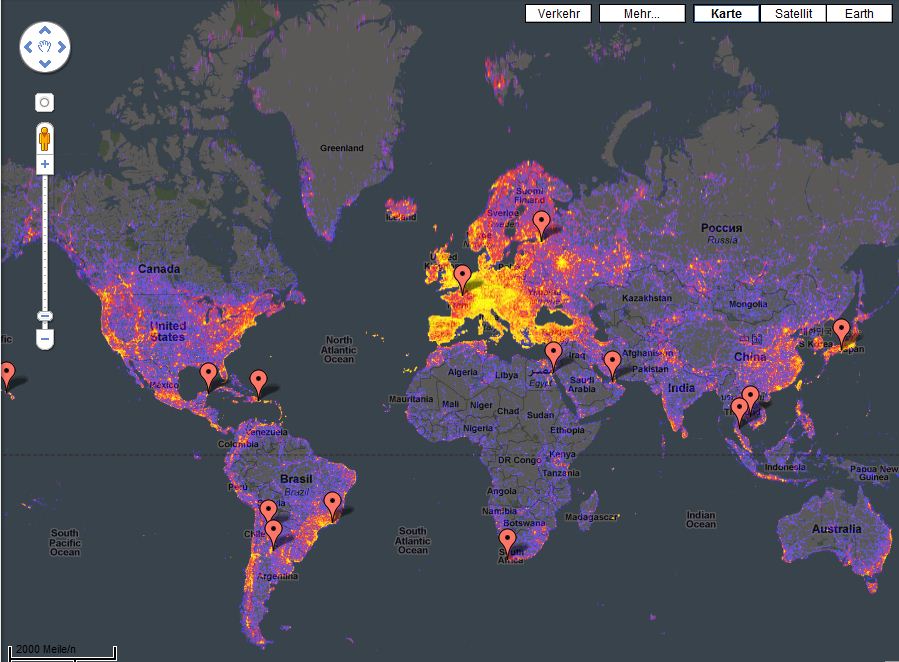
World touristiness map: World map color-coded by level of touristiness, based on analysis of photos on Panoramio. Yellow indicates high touristiness, red medium touristiness, and blue
low touristiness. Areas having no Panoramio photos at all are grey. The
analysis takes into account how many photos and by how many authors there are in a given area.
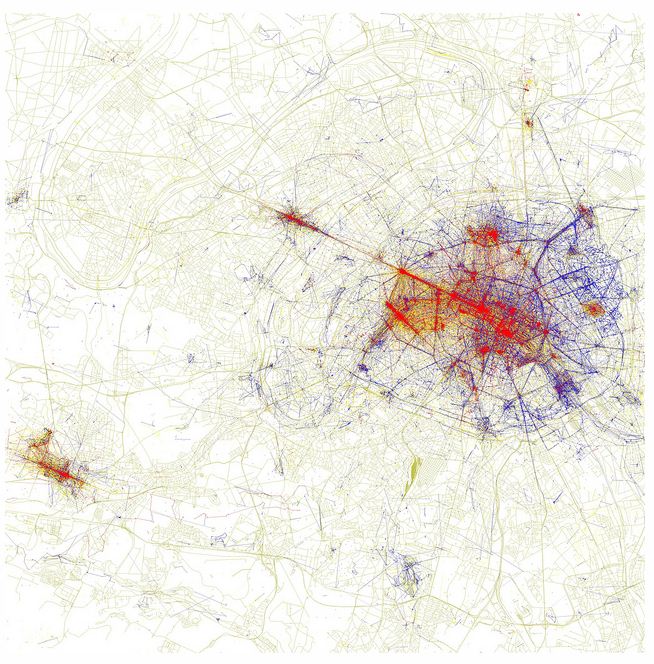
Fotos taken by tourists (red) and locals (blue) in Paris
The numbers as we have them:
|
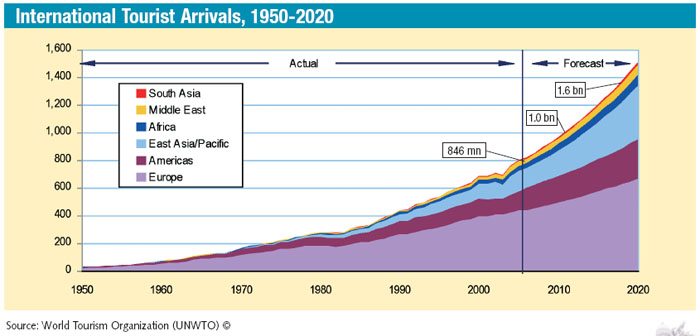
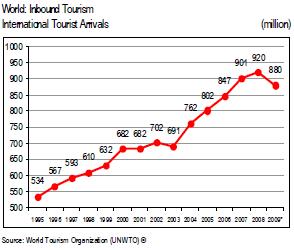
1995: 534
million arrivals 2010 (p.): 920 million arrivals
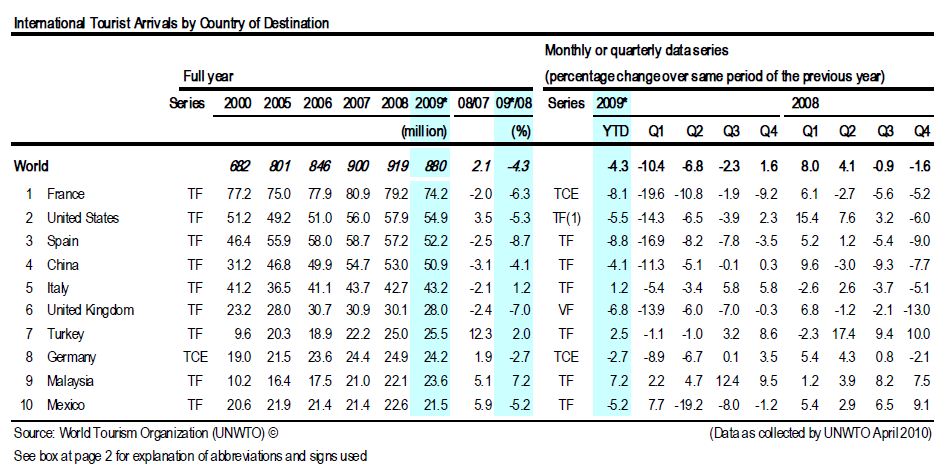
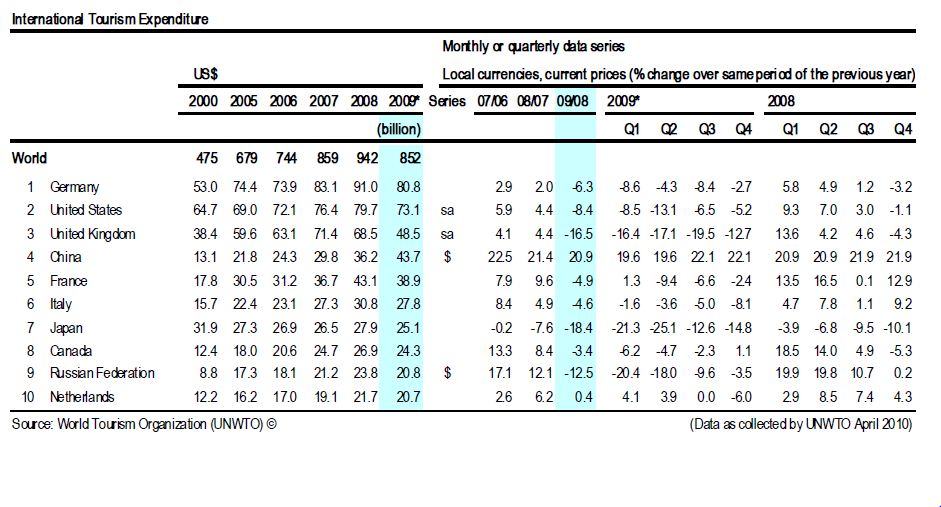
UNWTO latest figures for international tourism: Barometer August 2010
|
|
And how about domestic tourism?
|
|