|
China's outbound investment to
exceed FDI for first time in 2009
Against the backdrop of the international financial crisis, China's outbound
direct investment is expanding rapidly while international capital flow,
transnational investment, and mergers and acquisitions are dropping sharply.
This year, China's outbound foreign direct investment (FDI) is expected to
exceed FDI into China for the first time, reaching 150 billion U.S. dollars.
China's actual use of FDI amounted to 48.4 billion U.S. dollars in the first
seven months of the year, down by 20 percent over the same period last year.
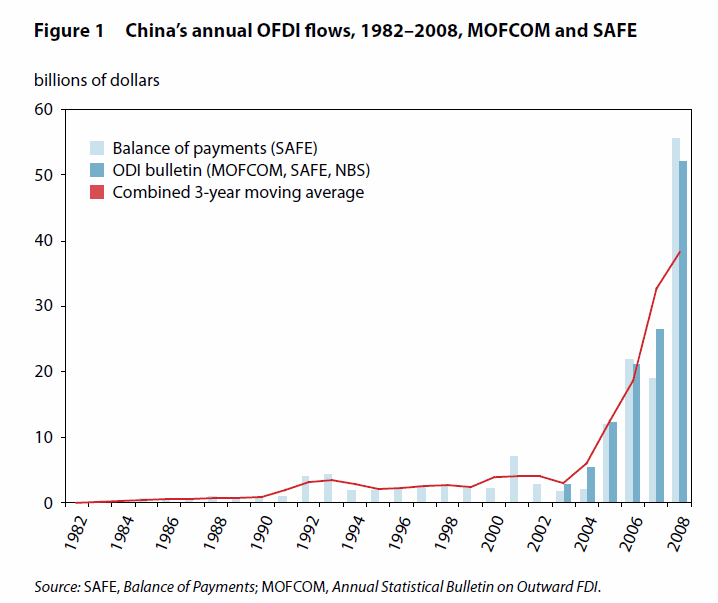
China's overseas investment reached 52.1 billion U.S. dollars in 2008, nearly
double that of 2007.
China's outbound investment has upgraded from its early stage into a stage of
rapid development, and China's role in the global economy will shift from
"manufacturer" to "capital exporter."
Fan Chunyong, standing director of China Industrial Overseas Development and
Planning Association explained the reasons for that. Firstly, 30 years of
economic development has enabled China to accumulate a large amount of
capital. Chinese capital will naturally flow overseas if that market has
lower cost and higher profit than domestic investment.
Secondly, with increasing economic globalization, China has broad access to
the transnational production processes and global production networks.
Chinese companies have a strategic need to invest in overseas upstream
production and downstream markets to guarantee the stability of their supply
chains and target markets, and prevent external factors from causing
uncertainty in their overall production and operation.
Thirdly, against the backdrop of the global financial crisis, many countries
are facing serious funding shortages and have huge demand for foreign
capital. At present, many foreign enterprises are successively coming to
China to find buyers. Holding the world's highest foreign exchange reserve of
almost 2 trillion dollars, China has plentiful capital.
In addition, costs for capital market are relatively low due to the strong
Chinese currency. All of these factors are naturally driving Chinese
enterprises to seize overseas investment opportunities.
By People's Daily Online
|