"If the world is going to be able to grow at a strong, sustainable pace
in the future . . . then we need to work to achieve more balance in the
pattern of global growth as we recover from the crisis,"
Treasury
Secretary Timothy F. Geithner said in a prepared statement after the
finance ministers concluded marathon talks in the South Korean city of
Gyeongju.
"This requires a shift in growth strategies by countries that
have traditionally run large trade and current account surpluses away
from export dependence and toward stronger domestic demand-led growth."
(Washington Post, Oct. 23, 2010)
Bretton Wood: Fixed exchange rates, government trying to control global economy, ending in 1973
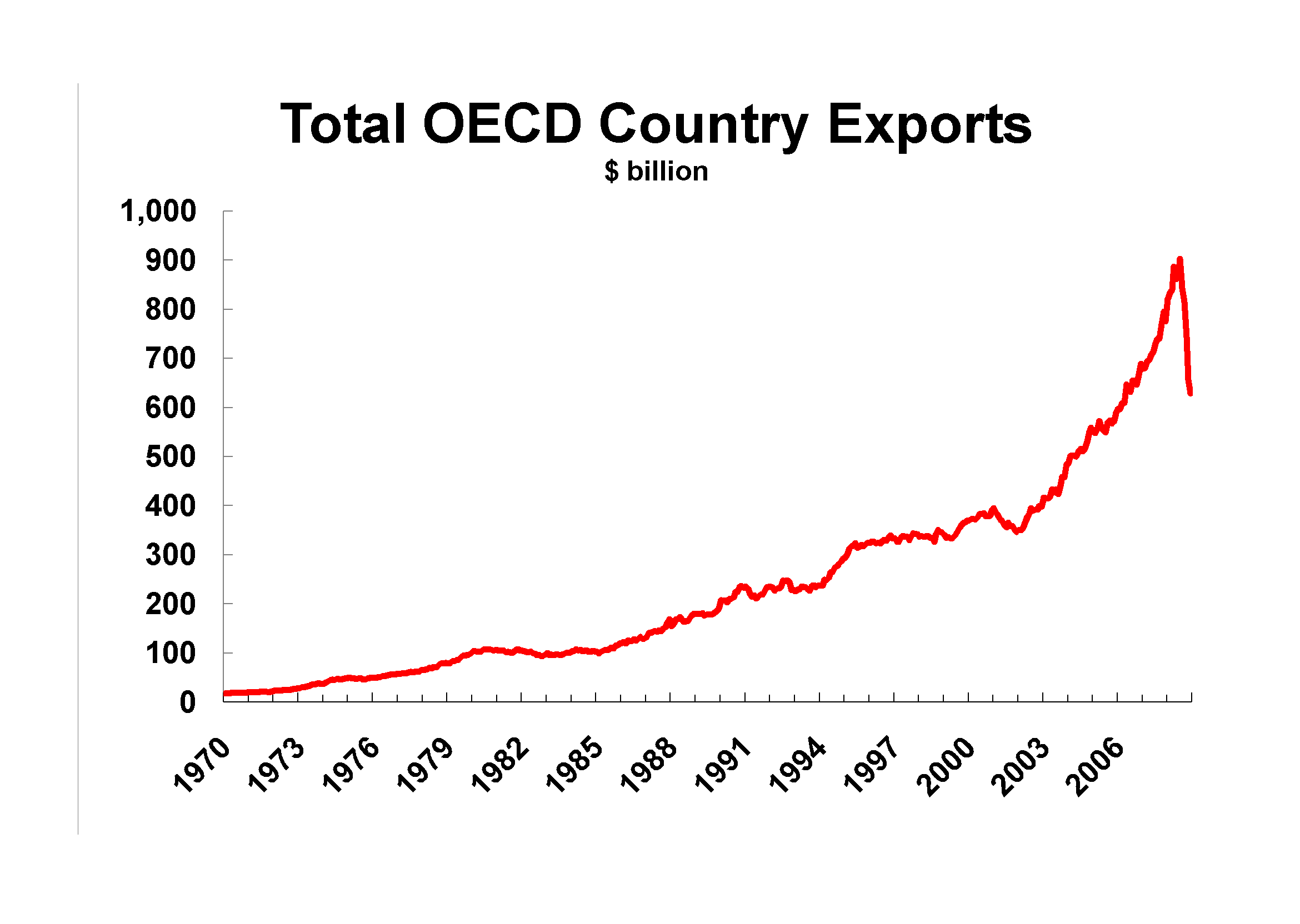
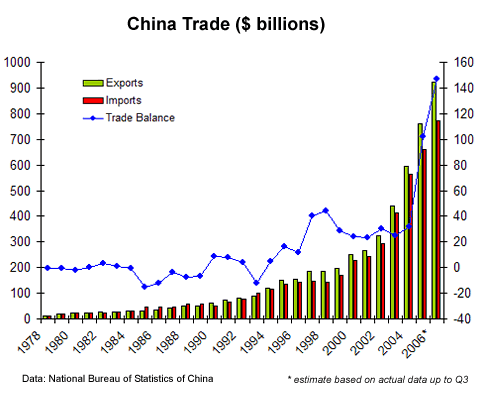
Strong growth of global trade starting in 1970s
After 1990 three developments:
* Internationalization of trade and finance
* Increased power of transnational corporations
* Enhanced role of international economic institutions

Two mainstream approaches of the Bush Decade (2001-2009):
neo-realism
and neo-liberalism
• More than just theories, neo-realism and neo-liberalism represent
paradigms
or conceptual frameworks that shape individuals' images
of the world and
influence research priorities and policy debates
and choices.
• Neo-liberalism in the academic world refers most often to neo-liberal
Institutionalism. In the policy world, neo-liberalism is identified
with the
promotion of capitalism and Western democratic values and
institutions.
• Rational choice approaches and game theory have been integrated
into
neo-realist and neo-liberal theory to explain policy choices
and the behaviour of
states in conflict and cooperative situations.
• Neo-realist and neo-liberal theories are status-quo oriented
problem solving
theories. They share many assumptions about actors,
values, issues and power
arrangements in the international system.
Neo-realists and neo-liberals study different worlds. Neo-realists
study security
issues and are concerned with issues of power and
survival. Neo-liberals study
political economy and focus on cooperation
and institutions.
• Structural Realists minimize the importance of national attributes
as
determinants of a state's foreign policy behaviour. To these
neo-realists, all
states are functionally similar units, experiencing
the same constraints
presented by anarchy.
• Structural Realists accept many assumptions of traditional
realism. They
believe that force remains an important and effective
tool of statecraft and
balance of power is still the central mechanism
for order in the system.
• Contemporary neo-liberalism has been shaped by the assumptions
of
commercial, republican, sociological, and institutional Liberalism.
• Commercial and republican Liberalism provide the foundation
for current
neo-liberal thinking in Western governments. These countries
promote free
trade and democracy in their foreign policy programmes.
• Neo-liberal Institutionalism, the other side of the neo-neo
debate,
is rooted in the functional integration theoretical work
of the 1950s and 1960s
and the complex interdependence and transnational
studies literature of the
1970s and 1980s.
• Neo-liberal Institutionalists see institutions as the mediator
and the means
to achieve cooperation in the international system.
Regimes and institutions help govern a competitive and anarchic
international
system and they encourage, and at times require, multilateralism
and
cooperation as a means of securing national interests.
• Neo-liberals believe that states co operate to achieve absolute
gains and the
greatest obstacle to cooperation is 'cheating' or
non compliance by other states.
• Neo-realists explain that all states must be concerned with
the absolute and
relative gains that result from international agreements
and cooperative efforts.
Neo-liberal institutionalists are less
concerned about relative gains and consider
that all will benefit
from absolute gains.
• Globalization has contributed to a shift in political activity
away from the state.
Transnational social movements have forced
states to address critical
international issues and in several situations
that have supported the
establishment of institutions that promote
further cooperation and,
fundamentally challenge the power of states.
• Neo-realists think that states are still the principle actors
in international
politics. Globalization challenges some areas of
state authority and control; but,
politics is still inter-national.
• Neo-realists are concerned about new security challenges resulting
from
uneven globalization, namely, inequality and conflict.
• Globalization provides opportunities and resources for transnational
social
movements that challenge the authority of states in various
policy areas.
Neo-realists are not supportive of any movement that
seeks to open critical
security issues to public debate.
• Free market neo-liberals believe globalization is a positive
force.
Eventually, all states will benefit from the economic growth
promoted by
the forces of globalization.
They believe that states
should not fight globalization or attempt to control it
with unwanted
political interventions.
• Most analysts agree after the end of the Bush Decade: Neo-liberalism and
neo-realism brought us into the mess we are
in today.
2010: The end of neo-liberalism, Seoul (Nov.) to confirm stronger role of politics.
"It's very clear we're in the middle of a paradigm shift.
We are witnessing the end of the neo-liberal project."
Phillip Blond, recently anointed
the "Philosopher King" of the British Conservative Party.
He is attached
to the British think tank, Demos, and has been tasked with
articulating a new philosophy for the Tories.
David Cameron launched Blond's Progressive Conservatism project.
At the Davos Conference 2009, he argued for
"conservatism with a conscience"
instead of "markets without morality".