|
Political Dimension of Globalisation
From Münster to Brussels to Beijing
Empires were based on dynasties, trading empires on economics rather than politics (Hanse).
Nation states centralize power and establish (by force) an internationally established system of sovereign legal entities.
National governments lose power to TNCs, but international political institutions gain power
The globalization of world politics
• Over the last three decades the sheer scale and scope of global
interconnectedness has become increasingly evident in every sphere
from the economic to the cultural. Sceptics do not regard this as
evidence of globalization if that term means something more than
simply international independence, i.e. linkages between countries.
The key issue becomes what we understand by the term 'globalization'.
• Globalization is evident in the growing extensity, intensity,
velocity and deepening impact of worldwide interconnectedness.
• Globalization denotes a shift in the scale of social organization,
the emergence of the world as a shared social space, the relative
de-territorialization of social, economic and political activity,
and the relative de-nationalization of power.
• Globalization can be conceptualized as fundamental shift or
transformation in the spatial scale of human social organization
that links distant communities and expands the reach of power relations
across regions and continents.
• Globalization is to be distinguished from internationalization
and regionalization.
• The contemporary phase of globalization has proved more robust
in the aftermath of September 11th and the 2008/2009 global economic
crisis than the sceptics recognize.
• Contemporary globalization is a multi-dimensional, uneven,
and asymmetrical process.
• Contemporary globalization is best described as thick form
of globalization or globalism.
• Globalization is transforming but not burying the Westphalian
ideal of sovereign statehood.
• Globalization requires a conceptual shift in our thinking about
world politics from a primarily geopolitical perspective to the
perspective of globalized or global politics – the politics of worldwide
social relations.
• Global politics is more accurately described as distorted global
politics because it is afflicted by significant power asymmetries.
• Globalization creates a double democratic deficit in that it
places limits on democracy within states and new mechanisms of global
governance which lack democratic credentials.
Transnational actors and international
organizations in global politics
• The concept of the 'state' has three very
different meanings: a legal person, a political community, and a
government.
• The countries and governments around the
world may be equal in law, but have few political similarities.
Many governments control less resources than many transnational
actors.
• It cannot be assumed that all country-based
political systems are more coherent than global systems, particularly
as national loyalties do not match country boundaries.
• By abandoning the language of 'states'
and 'non state' actors, we can admit the possibility of theorizing
about many types of actors in global politics. By distinguishing
government from society and nation from country, we can ask whether
private groups, companies, and national minorities in each country
engage in transnational relations.
• The ability of Transnational Companies
(TNCs) to change transfer prices means that they can evade taxation
or government controls on their international financial transactions.
• The ability of TNCs to use triangulation
means individual governments cannot control their country's international
trade.
• The ability of TNCs to move production
from one country to another means individual governments are constrained
in regulating and taxing companies.
• The structure of authority over TNCs generates
the potential for intense conflict between governments, when the
legal authority of one government has extraterritorial impact on
the sovereignty of another government.
• In some areas of economic policy, governments
have lost sovereignty and regulation now has to be exercised at
the global level rather than by governments acting independently.
• Effective action against transnational
criminals by individual governments is difficult for the same reasons
as control of TNCs is difficult.
• Groups using violence to achieve political
goals generally do not achieve legitimacy, but sometimes they
may be recognized as national liberation movements and take part
in diplomacy.
• The transnational activities of criminals
and guerrillas shift problems of the domestic policy of countries
into the realm of global politics.
• Terrorism may be particular to individual
countries, have transnational aspects or be carried out by groups
in a transnational network, but it is not a single political force.
• Most transnational actors can expect to
gain recognition as NGOs by the UN, provided they are not individual
companies, criminals, or violent groups, and they do not exist solely
to oppose an individual government.
• The creation of a global economy leads
to the globalization of unions, commercial bodies, the professions,
and scientists in international NGOs, which participate in the relevant
international regimes.
• Governments can no longer control the flow
of information across the borders of their country.
• Improved communications make it more likely
that NGOs will operate transnationally and make it very simple and
cheap for them to do so.
• NGOs from each country may combine in four
ways, as international NGOs, as advocacy networks, as caucuses,
and as governance networks.
• International organizations are structures
for political communication. They are systems that constrain the
behaviour of their members.
• Governments form intergovernmental organizations
and transnational actors form international non-governmental organizations.
In addition governments and transnational actors accord each other
equal status by jointly creating hybrid international NGOs.
• A simple concept of power will not explain
outcomes. Military and economic resources are not the only capabilities:
communication facilities, information, authority, and status are
also important political assets. In addition, an ability to use
the interaction processes to mobilize support will contribute to
influence over policy.
• TNCs gain influence through the control
of economic resources. NGOs gain influence through possessing information,
gaining high status and communicating effectively. TNCs and NGOs
have been the main source of economic and political change in global
politics.
Global Political Decision-Making: Example United Nations
• The United Nations was established to preserve peace between
states after the Second World War.
• In a number of ways, the institutions of the United Nations
reflected lessons learned from its predecessor, the League of Nations.
• The institutions and mechanisms of the United Nations reflect
both the demands of Great Power politics (ie. Security Council veto)
and universalism.
• After the cold war, it became more difficult for states and
diplomats to accept that what happened within states was of no concern
to outsiders.
• It became more common for governments to see active membership
in the United Nations as serving their national interest as well
as being morally right.
• By the mid-1990s the UN had become involved in maintaining
international peace and security in three main ways: by resisting
aggression between states, by attempting to resolve disputes within
states (civil wars), and by focusing on conditions within states,
including economic, social and political conditions.
• Operations of the United Nations were justified in the traditional
way: as a response to a threat to international peace and security.
• Any relaxation of the traditional principle of non-intervention
had to be treated very cautiously, and new methods of approval in
the UN could be advisable.
• The number of institutions within the UN system that address
economic and social issues has significantly increased. Several
Programmes and Funds were created in response to Global Conferences.
• Coordination between the various economic and social organisations
has been problematic.
• Despite a shortage of funds and
coordination problems, the UN has done important work in key economic
and social areas.
• In the late 1990s under the leadership
of then Secretary-General Kofi Annan, the UN embarked on an overarching
reform effort, which however was not very successful until now and
not actively supported by the new Secretary-General Ban Ki-Moon.
Example United Nations
peacekeeping missions today:
Current Operations
Africa
Americas
Asia and the Pacific
Europe
Middle East
Based mainly on: Baylis & Smith: The Globalization of World
Politics
2010: The western political models meets a new rival:
THE ECONOMIST
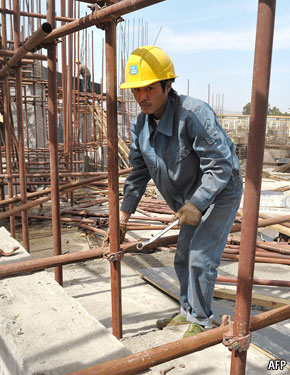
Ethiopia and China
Looking east
Meles Zenawi’s new best pal
Oct 21st 2010 | ADDIS ABABA
The EPRDF won all but two of the 547 parliamentary seats in a general
election in May.
So much for its promotion of plurality. Government
supporters point to wider ethnic
diversity within the party, with
support said to be growing among the Amharas and
Oromos, two ethnic
groups. But the security apparatus remains in the hands of Mr
Meles’s
Tigrayan minority. Mr Meles has been in power since 1991. Ethiopia has
no term
limits, but he says he will step down in 2015.
Mr Meles’s contempt for what he calls the “neoliberalism” of the West
is as plain as his
admiration for “generous” and “dependable” China.
Chinese Communist Party officials
were feted at a recent EPRDF
conference. Hailemariam Desalegn, the new foreign
minister and deputy
prime minister, has been conspicuous in urging Ethiopia to follow
China’s model.
Mr Meles argues that the free market has cost Africa decades of
development. By siding
with China, this will never happen again. The
Europeans and Americans find this galling,
since they continue to pay
for many of Ethiopia’s hospitals and schools, as well as handing
out
free food. But trade between Ethiopia and China is increasingly what
matters. It was
worth $800m in the first six months of this year, up by
27% on last year.
China has invested $2.5 billion in Ethiopia, mostly in
infrastructure. Mr Meles wants China
to take a lead in building a new
railway network. He has also promised to use Chinese
loans to build a
controversial dam on the Omo River in the south. And China has decided
to lend Ethiopia $234m so that nine vessels are built in Chinese
shipyards for the
Ethiopian Shipping Line, which operates out of
Djibouti.
Mr Meles’s ambitious plans to pep up his country of 85m people do not
include a stock
exchange. Enterprise, skills, and connectivity are
years behind neighbouring Kenya. But
Mr Meles is shrewd. He hopes
Ethiopia’s massive trade deficit will narrow as his country’s
new
factories export goods under preferential trade terms. Last year exports
to China
rose by 140%.
Case study: Tourism
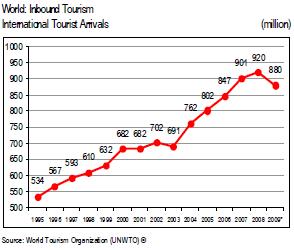
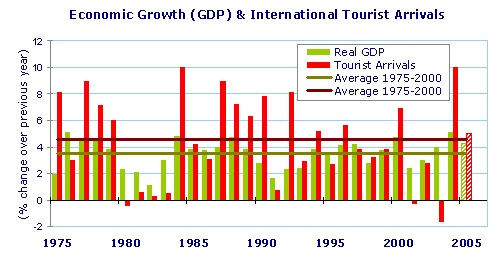
Global tourism has strongly developed, outperforming the growth of global economy.
Tourism is an agent of change, but also a recipient of change in the economic and political system of globalisation.
Please form three groups and discuss in which ways tourism development is
- on the one hand a cause or a catalyst of globalisation and
- on the other hand a recipient of globalisation
Please give some examples for both "sides of the coin" after 30 min.
|