Scientists have performed successful teleportation on atoms for
the first time, the journal Nature reports.
The feat was achieved by two teams of researchers working independently on
the problem in the US and Austria.
The ability to transfer key properties of one particle to another without
using any physical link has until now only been achieved with laser light.
Experts say being able to do the same with massive particles like atoms could
lead to new superfast computers.
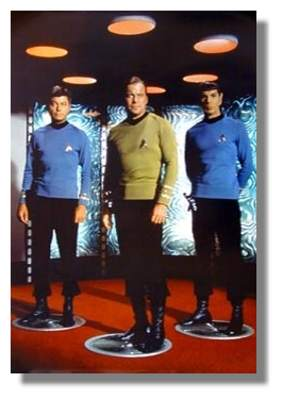
This development is a long way from the transporters used by Jean-Luc Picard
and Captain Kirk in the famous Star Trek TV series.
When physicists talk about "teleportation", they are describing
the transfer of "quantum states" between separate atoms.
These would be such things as an atom's energy, motion, magnetic field and
other physical properties.
And in the computers of tomorrow, this information would form the qubits (the
quantum form of the digital bits 1 and 0) of data processing through the
machines.
Atomic dance
What the teams at the University of Innsbruck and the US National Institute
of Standards and Technology (Nist) did was teleport qubits from one atom to
another with the help of a third auxiliary atom.
It relies on a strange behaviour that exists at the atomic scale known as
"entanglement", whereby two particles can have related properties even when they
are far apart. Einstein called it a "spooky action".
The two groups used different techniques for achieving
teleportation, but both followed the same basic protocol.
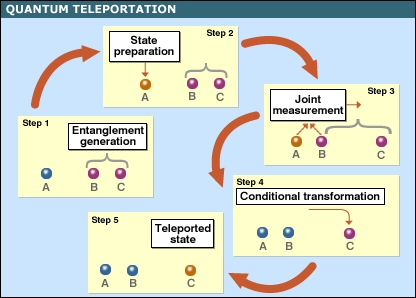
First, a pair of highly entangled, charged atoms (or ions) are created: B and
C. Next, the state to be teleported is created in a third ion, A.
Then, one ion from the pair - let's say B - is entangled with A. The internal
state of both these is then measured and the result sent to ion C.
This transforms the quantum state of ion C into that created for A,
destroying the original quantum state of A.
The teleportation took place in milliseconds and at the push of a button, the
first time such a deterministic mechanism has been developed for the process.
'Great potential'
The landmark experiments are being viewed as a major advance in the quest to
achieve ultra-fast computers, inside which teleportation could provide a form of
invisible "quantum wiring".
These machines would be able to handle far bigger and more complex loads than
today's super-computers, and at many times their speed.
"In a quantum computer it's straightforward enough to move quantum
information around by simply moving the qubits, but you might want to do things
very quickly, so you could use teleportation instead," said Nist's Dr David
Wineland.
Professor Rainer Blatt, of the University of Innsbruck, told BBC News Online:
"This is a milestone.
We are able to teleport in a deliberate way - that is, at the push of a
button. This has been done before, but not in such a way that you can keep the
information there at the end."
Professor Blatt's team, an Austrian-US group, performed the teleportation on
calcium ions. The Nist team in Boulder, Colorado, used ions of the element
beryllium.
Despite this and some differences in the experimental methods used by the two
groups, both teams reached similar values of fidelity - around 0.75.
Fidelity is a measure of how well the quantum state of the second ion after
teleportation resembles the original quantum state.