|
INTRODUCTION
Some ideas about SoCo:
Industrial age: »The big are eating the small«
Service age: »The fast are beating the slow«
Knowledge age: »Socially competent companies win
against socially incompetent companies«
Social competence important in life of a
person AND in life of a company.

Jozef Vyrost,
Marek Dobes (2004):
Social cohesion grows up from natural small groups. Family, classroom,
working team etc. are real life “stadiums” of social competence. Natural small
social group settings thus facilitate (or hinder) effective interaction of an
individual and society and in this sense form a complement to traditional
knowledge in a knowledge-based society.
The term competence became popular in
developmental psychology in connection with the need to define the criteria of
cognitive, emotional etc. maturity in adolescence.
The
adjective social has stressed the requirements that the ”essence” could
not be seen just inside the individual, but mainly in his/her skills to
accommodate effectively the demands of environment. Social competence (SoCo)
refers to the social, emotional, and cognitive skills and behaviours that people
need for successful social adaptation.
In the last decades the social competence concept has become popular,
which was supported by:
- Tendency to apply the criteria of effectiveness of social behaviour
(in the sense of social acceptability and assertivity) to all periods of human
development
- Striving to express the multidimensionality of the concept
(identification of different social skills as components of SoCo or
distinguishing inside SoCo the cognitive, emotional, social, personal etc.
competence).
Social competence has been defined first in terms of social
skills. For example Sarason (1981) discussed the dimensions of social
competence that she believed were essential to socially competent functioning;
this list included problem solving behaviour, perspective taking, and person
perception. In the second approach to defining social competence, more emphasis
has been placed on the social outcome and social competence is defined as
the ability to be effective in the realization of social goals (e.g. Anderson,
Messick, 1974).
Next scheme visualises chain of causal interactions
between an individual and his/her social world. Social competence serves as an
important mediator in both the situations when an individual attempts to
influence his/her social environment and also in the situations when a person is
required to cope with demands of society.

Social competence manifested its potential in explanation
of a paradox that people highly competent in one type of cultural setting, one
life domain or situation could have serious problems in different social context
(e.g. a little Indian in Paris or his dad in tribe). Social competence for these
reasons could be seen sometimes as an elusive concept, because the skills and
behaviours required for healthy social development vary with age, gender, status
etc. and with demands of particular situation.
Mentioned elusiveness or trans-situational variability of
social competence opens up the question of normative determination of any social
behaviour. (Referee’s whistling on the whistle, as a tool of management people’s
activity could be fully accepted as competent on a football stadium but probably
totally unacceptable in his family life, because norms and rules in these
settings are different.)
To sum up, social competence is highly dependent on
social environment and on situation. Same behaviour may be highly competent in
some cultures (sub-cultures, groups) and situations and incompetent in others.
One of effective ways how to deal with social context
relativity is to operationalise cultural settings with the use of norms. Table 1
shows criteria used to evaluate success of social competence:
Table 1: The criteria used in the processes of evaluation of social
competence
|
LEVEL |
CRITERIA |
|
Society |
Legal system |
|
Large social groups |
Explicit(legal) & implicit(ethical) norms |
|
Small groups |
Group norms |
|
Individual |
Injunctive&descriptive&personal
norms |
A useful way how to deal with situational context relativity is to
adopt so-called person-by-situation approach (see e.g. Magnusson, 1981). This
approach takes into consideration mutual interference of personality traits and
other psychological characteristics and situational characteristics in producing
resulting behaviour.
In spite of relativity of context in which social competence is used,
there still may be identified a larger number of “factors” and social skills,
social awareness, self – confidence, self-esteem etc. are mostly between
them.
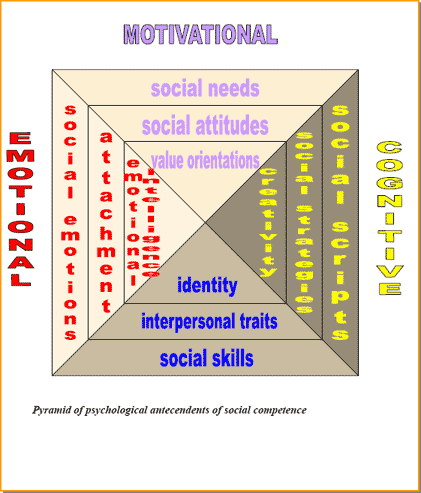
Table 2: Psychological antecendents of social
competence
|
PERSONALITY A. |
COGNITIVE A. |
MOTIVATIONAL A. |
EMOTIONAL A. |
|
Self-concept,
Identity |
Social intelligence, Creative intelligence |
Value orientations,
in-strumental
& terminal |
Emotional intelligence |
|
Interpersonal traits |
Social strategies |
Social attitudes |
Attachment |
|
Social skills |
Social scripts |
Social needs |
Social emotions |
Leadership Qualities: Authentic, self-confident, holistically
competent
Personality competence
Self-management
Communicative competence
Conflict competence
|