|
Preparation
Step 1: Decision-making on traveling
or not
Influences:
? Cultural background
? Cohort travel behaviour
? Personal situation
? Situation in preferred destination
Step 2: Decision process on traveling
when and where to
Influences:
? Cultural background
? Cohort travel behaviour
? Personal situation
? Climatic / political / security Situation in preferred destination
Step 3: Decision process on the purchase process for ackage
tour / tickets / accomodation:
$ Personality of the purchaser
$ Point of purchase
$ Role of the sales person / website
$ Frequent or infrequent purchaser of tourism products
$ Prior experience of the destination / of traveling
|
How do you decide on a purchase
of tourism products?
Please
describe.
|
|
What influences do you see on the perception
of
$ price / value for
money
$ distance to
destination
|
Sources of Information for preparation
|
"Post-industrial societies are literally saturated with tourist culture,
which originates from increasingly widespread and intensive channels of
information, so that motivation and anticipation are now packed with meanings
that would have been impossible to note 15 years ago." (Parrinello 1993)
|
Information channels have increased from
the traditional forms of travelogues, guidebooks, travel tales of
friends
to films, TV programs including special travel channels
to virtual reality (Internet)
with new developments still arriving (f.i. mobile phone real-time
pictures instead of printed postcards)
Some examples for Germany from DZT website / Guide books / tourism science
books:
http://www.germany-tourism.de/
http://www.lonelyplanet.com/destinations/europe/germany/index.htm
"Germany has a lack of domestic attractions. The climate is not good for
summer sun holidays and there is a relative lack of stylish coastal resorts and
picturesque cities." (Swarbrooke/Horner 1999, p. 41)
| Example: Aroung 1990, Japanese Tourists visiting Canada became fascinated
with the TV character "Anne of Green Gables". This was something they expected
to see when they came to Canada. Before Anne was on Japanese TV, there was no
such demand. Also it was unknown to other. f.i. German, tourists. |

|
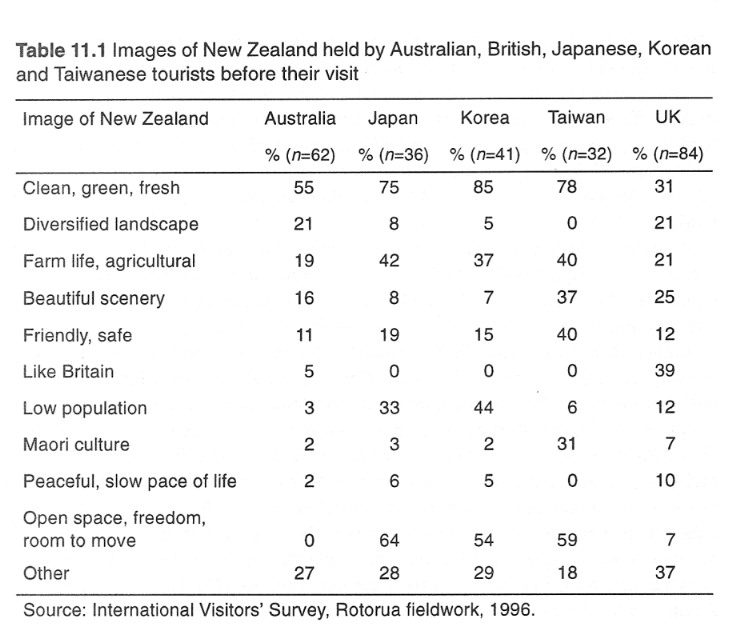
Example New Zealand
|
Let us look at our image of a destination,
taking the example
New Zealand
Let us make
a ranking by giving each of the following images of
New Zealand a score according to its fitting (0=not
fitting, 10= very fitting):
Clean, green, fresh
Diversified
landscape
Farm life, agricultural
Beautiful scenery
Friendly,
safe
Like Great Britain
Low population
Maori
culture
Peaceful, slow pace of life
Open space,
freedom, room to move
|
|
How can
you influence positively the expectations of tourism
customers before they start their travel?
And
what will happen if your product
can not deliver on the positive
expectations?
|
|