|
|
Characteristics of Services and their Implications
for the Tourism Labor Force
Characteristics:
- Sale, production and consumption take place
(almost) simultaneously
- No central provision, inspection, stockpiling or
warehousing
- No sampling, demonstrating, testing
- No tangible product bought by the
customer
- No sharing, passing on or giving away of
product/experience
- Almost always human contacts involved
- No quality control without monitoring
- No replacement of faulty product
- Standardisation either not at all or almost
completely
Reminder: Characteristics of Tourism Labor
Force:
- young (first job)
- high level of fluctuation
- many entries
from other industries ("Quereinsteiger")
- high percentage of
women
Implications:
1. Customers perception of service quality directly
linked to performance of front-line staff
2. Manager have to be responsive to staff instead
of being responsible
3. Quality measured by customers satisfaction, not
quantitative output
4. Union power / "Dienst nach Vorschrift" of staff
increases
5. Need for adaptive, decentralized, downsized
organisation structure
--> "THE MOMENT OF TRUTH"
Carlzon (CEO of SAS 1981-1993): "THE MOMENT OF TRUTH"
THE CARLZON PHILOSOPHY
In 1981 Scandinavian Airlines System,
SAS as it is known in the industry, was struggling with a severe downturn in
business and an accumulated two year deficit of $ 30 (Skr 150) million after 17
consecutive profitable years. The worldwide recession had cut deeply into the
airline industry and the multinational board of directors of SAS was
understandably concerned. The new SAS boss, Jan Carlzon, believed that SAS had
become an "Introverted" organization which had lost its fix on the customers'
needs. He felt that management had been putting almost all its attention on the
mundane aspects of flying airplanes and not enough on the quality of the
customers' experience.
In contrast to the conservative and
stately Scandinavian tradition, he wanted to change the airline from a
technical and production oriented company to a market focused
company, by making all personnel obsessively aware of customer
service. He believed he could force attitudinal and structural changes in
SAS that would bring the delivery system into harmony with their customers'
needs. This, he reasoned, would get the market to recognize a significant
difference between SAS and all other airline choices.
A service company, he argued, needed a
different approach to the customer from that of other manufacturers. SAS, he
pointed out, is not the airline, or head office, or an overhaul station, it's
the contact between one customer in the market and one SAS employee in the front
line. He demonstrated this by an idea which he called "the moment of truth," an
episode in which a customer comes into contact with any aspect of the company,
however remote, and thereby has an opportunity to form an impression. "SAS," he
declared, "had 50,000 moments of truth out in the market every
day."
The marketing concept was new to SAS.
The international airline had been shaped by a strong heritage of engineering.
The former president, Knut Hagrup, an aeronautical engineer, was reputed once to
have said to an executive, "I know all about airplanes. I have good people on
finance. I don't know anything about marketing."
Executives had regarded the buying of
even larger and faster airplanes as their most important responsibility. Said
Carlzon; "We used to think our biggest assets were aircraft, overhaul
stations and technical resources. But we have only one real asset, and that is a
satisfied customer prepared to come back to SAS and pay for our costs once
more. That's why the assets in our balance sheet should show the number of
satisfied customers who flew SAS during the year, and not the number of
airplanes which are not worth one single cent as long as there is no second-hand
market in the world for used aircraft, and nobody wants to pay for a flight in
those airplanes. So it's really fooling the banks to use these as the
assets."
(The Economist)
BOOK:
http://www.amazon.com/exec/obidos/ASIN/0060915803/002-1708814-7521652
|
CONSEQUENCE:
Paradigm Process-orientated
Organisation in Tourism
Starting point:
Personal administration vs.
Personal development
 "Classical" way of organisation: By
"Zuständigkeit" "Classical" way of organisation: By
"Zuständigkeit"
(note the difference with "responsibility" or
"compentence")
"Integrated" way of organisation: By
"Customer Satisfaction"
Example:
IBIS 15 min. Guarantee
How
can it work?
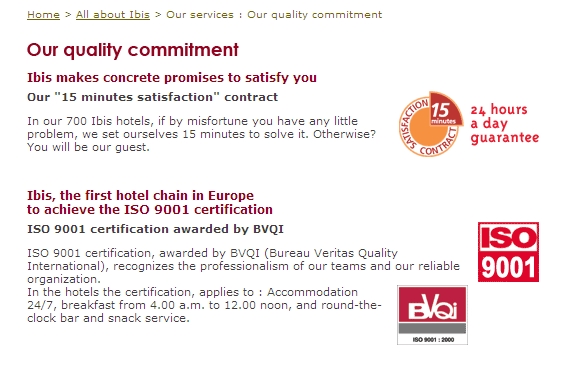
http://www.ibishotel.com/gb/discovering-ibis-hotel/quality-commitment/index.shtml
http://www.hotel-online.com/News/PR2003_1st/Feb03_IbisGuarantee.html
Ibis Hotels Launch new '15 Minute Guarantee'
Scheme;
15 Minutes Up...Or The Room's On The
House |
|
12 February 2003: Accor's Ibis hotel group is putting
its money where its mouth is. If a problem can't be solved in 15 minutes, the
guest's room is free.
Ibis is the first hotel group in Australia and New Zealand to introduce such
a pioneering customer satisfaction guarantee.
The 15 Minute Guarantee will be
implemented across the network of 12 Ibis hotels in Australia and New Zealand.
The Guarantee, combined with the hotel brand's revolutionary People's Price
strategy, makes Ibis an unbeatable option for smart travellers wanting value for
money without sacrificing on service.
"At all Ibis hotels our philosophy of value, efficiency and transparency is
epitomised in a service excellence program which incorporates ongoing staff
training and programmes to ensure continuing improvements across all
departments," said Roger Batty,
Accor's General Manager Economy Hotels.
The Ibis 15 Minute Guarantee is our promise to guests that if they are not
completely satisfied with any aspect of their room and we can't fix it within 15
minutes, they will not be charged.
"With the launch of the Ibis 15 Minute Guarantee we are showing our customers
that while our facilities have been adapted to ensure our guests get the best
price possible, our service is absolutely first class."
Batty admits that at first some of the hotel general managers were sceptical
about introducing such a programme, but trials have shown that 98.4% of comments
were actioned within 15 minutes or less.
"Introducing this programme was a great way to motivate our staff and
highlight that their contribution is vital to guest satisfaction," Batty said.
"Too many hotels think that facilities are everything. Most people will tell you
it is the human element that is principal in guests enjoying their stay and we
aim to have our staff offer the highest level of efficient and friendly
service."
Based on a month-long trial during which the test hotels sold 3474 rooms,
only 11 issues could not be fixed within the specified time - which equates to
less than 0.0003%. The most popular guest requests were for extra towels, help
with using the remote controls for the television and for changes to the air
conditioning temperature.
Fewer than one in nine guests made any sort of request, and of those the vast
majority were minor and easily actioned.
"Some of our general managers expected a flurry of complaints about the
smallest things but what we found is that most people are honest and only expect
a free night's accommodation if there is something really wrong," Batty said.
"Before undertaking this initiative we introduced a comprehensive maintenance
programme to identify any possible areas of improvement and conducted extensive
staff training across all of our hotels. I am confident the Ibis network is now
ready to face the challenge."
Ibis is the leading 3-star hotel brand in Australia and New Zealand and is
renowned throughout the world for the hotels' quality, simplicity and value for
money. Hotels are conveniently located in central business districts and major
regional and suburban areas. There are 10 Ibis hotels in Australia and 2 in New
Zealand, with a network of more than 600 worldwide.
Accor is the worldwide leader in hotels, tourism and corporate services,
employing 150,000 people in 140
countries. |
Organisational Integration can only
be realised as
Personal Integration
Reification ("thingifying") of
Action  The organisation is
acting The organisation is
acting
System acts as result of actions of
"players" Persons are
acting
If
persons are seen as actors, an integrated organisation can only be
successfully developed by Human Resource Development
Stewardess Schaffner - Zugbegleiter | |
|