|
Leisure and Tourism is a people industry:
Without motivated employees it is almost impossible to be successful.
However, most people working in companies in a market economy are
not the owners of the company.
How to motivate employees
without giving over
the leadership and ownership of the company
to them?
Different forms of companies (from small
to big) in Leisure and Tourism:
|
Form of company
|
Branches
|
Consequences for Employee relations
|
|
One-person-company
|
Consulting, Holiday Flat Rental,
Inbound T.O., Shop, Entertainer, Mobile Take-away
|
Owner works for him/herself
|
|
Family-run business
|
B&B / Pension, Shop, Small
Museum, Farm, Boat Rental, Small Restaurant, Specialized
T.O., Travel Agency
|
Family relations
|
|
Family-run business with some
employees
|
as above, bigger in size,
Transport
Co.
|
Family-like relations
|
|
Privately owned and operated
company
|
as above, bigger in size,
Hotel,
attractions etc.
|
Mix of family-like and industrial
relations (mostly no union representation)
|
|
Privately owned, manager-operated
Co.
|
as above, maybe part of a chain
|
Manager also employee
|
|
Public-owned Co./Institution
|
Museum, Theater, DMO, Attraction
|
relations based on public sector
rules
|
|
National Listed Co.
|
Hotel Group, Airline, T.O.,
|
industrial relations (union representation
more likely)
|
|
International Listed Co.
|
as above, internationally engaged
|
industrial relations (union representation
more likely, but mostly on national level only)
|
|
|
|
|
Traditional instrument of employee
relations: Labor Unions
German approach: Sozialpartnerschaft,
strict collective labor agreements (Tarifvertrag)
DGB (Deutscher Gewerkschaftsbund: 1991 11
mio. members --> 2007: 6.4 mio. members
For Leisure and Tourism main unions within
DGB:
ver.di (including transport)
ngg (Nahrung-Genuss-Gaststätten)
(for tourism professors in FHs: hlb)
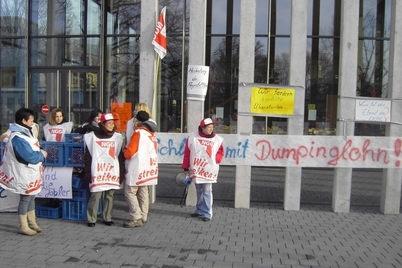
Strike
pickets in front of a University Mensa
What are the advantages
and disadvantages to organize employee relations
with the help
of labor unions?
In L+T, lower organisation grade than in
other industries because of:
- structure of the workforce: young,
part-time, minorities, seasonal, temporary
- SMEs with family-like structures
- conservatism and individualism in
the work ethos of the employees
- hostility towards labor unions by
the employers
But: Small groups of unionized workers can
make a big difference:
Examples: Air-traffic controllers, locomotive
drivers
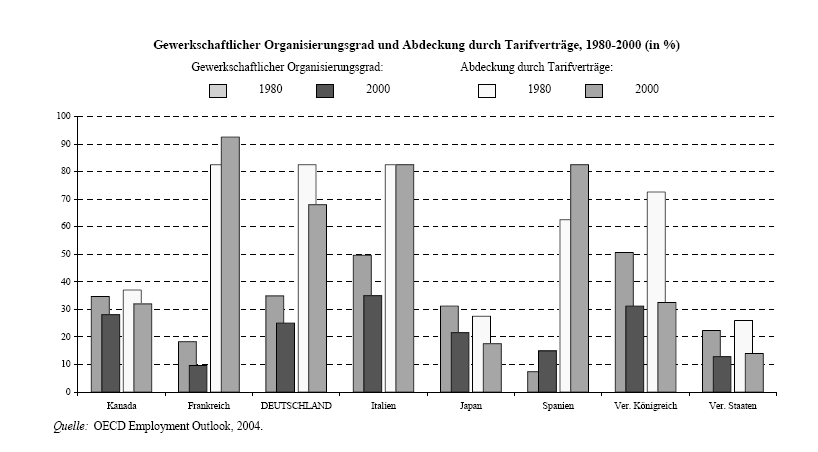
Union membership in decline
Other forms of employee relations:
- Involvement and Empowerment
- Information sharing, Teamwork
- TQM, Quality Circles
trying to achieve:
- Reduction in the social distance
- Less close supervision -> more
responsive service
- Enhanced motivation -> greater
commitment
- Manager can concentrate on problem-solving
and strategy
- WOM
BUT: Often gap between rhetoric and reality.
|