|
The editors of the first edition of the "Journal of Sustainable
Tourism" wrote in the introduction:
"Sustainable tourism is a positive approach intended to reduce the tensions
and frictions created by the complex interactions between the tourism industry,
visitors, the environment and the communities which are host to holiday makers…
an approach which involves working for the longer viability and quality of both
natural and human resources.” (Bramwell
and Lane, 1993: 2)
What does this
mean for HRM in Leisure and Tourism?
- create intrinsic instead of extrinsic
motivation (satisfaction vs. money)
- treat the human "resource"
just as this - the most important resource, which needs to be developed
with a long-term perspective.
Consequences:
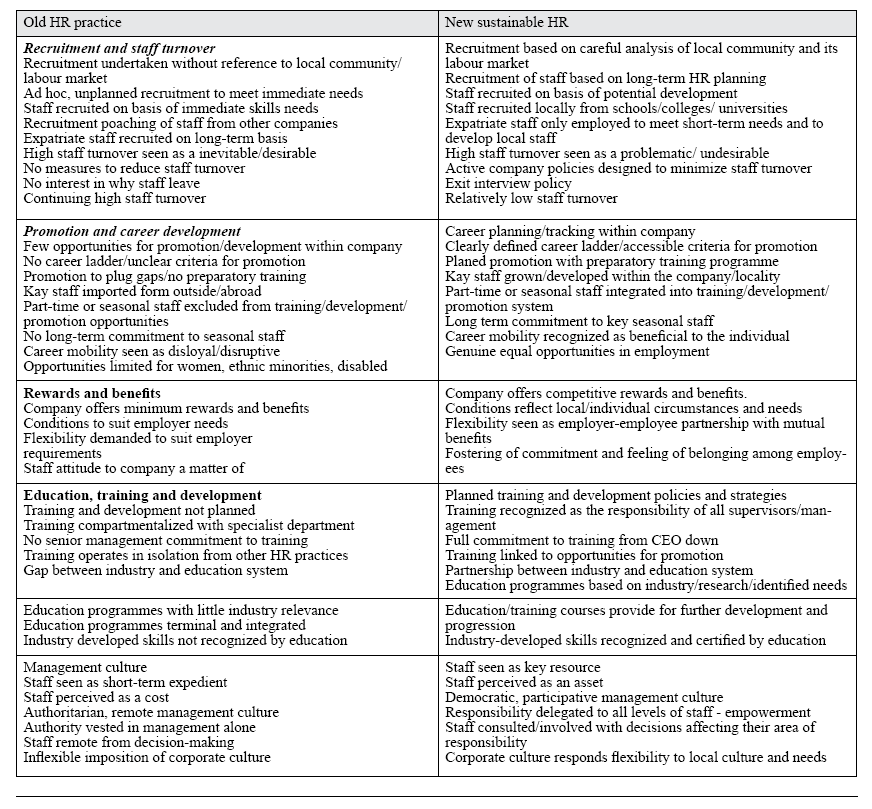
Source:
Baum 1995
Two seemingly incompatible trends:
- Service revolution (skilling of work)
- McDonaldization (de-skilling of work)
Most famous best case example: Scandic Hotels
(http://www.scandichotels.com/About-Us/Careers/)
From the website:
"Work and develop with us
A cook who became executive chef. A controller who became project manager. A
cleaner who became general manager. The development opportunities are huge at
Scandic. Start with us and there is every chance that you'll want to stay on.
6,600 team members serve millions of guests every year
Our business concept involves making travel easy for as many people as
possible. To help us on our way, we need skilled staff. If you are a people
person, working at Scandic could offer you great opportunities for personal
development. As well as having a wide choice of different jobs, you can also
apply for a job anywhere in the Nordic region. We want everyone who works here
to have the opportunity to grow, both as a person and in their professional
capacity. Today, around 6,600 people work for Scandic in the Nordic region. But
we always need more.
Committed to personal development
Competence and commitment are your contribution to Scandic. The opportunity
for a job offering development and excitement is our contribution back. Our
vision for team members is to create added value for everyone. "We will offer
secure and meaningful work in a developing environment, where performance
creates value for you, the guests and Scandic."
Further training at Scandic Business School
Skills development is key to Scandic's success. We offer great opportunities
for development in all our professions. Scandic Business School provides two
different types of training – from specialist courses such as "The art of
building up a buffet breakfast" to our internal management programme
Talent@Scandic, which in the long term can help you to become one of our
excellent managers.
We aim for our training programmes to cover all the areas within a hotel. You
should be able to find out everything you want and need to know to enjoy a
career with us right here.
Our cross-training also allows you to switch workplace with a colleague at
another hotel. This enables you to broaden your skills, meet new people and then
take your experiences back to "your" hotel.
School's over, but we're always learning
Knowledge often has a short shelf-life; what was important to know a few
years ago is out of date today. As the world changes, the demands on Scandic,
its work and the people who work here change.
The Knowledge Portal is the technological platform that enables us to monitor
the progress of team members within Scandic. This is the gateway to your
development and training opportunities. All the courses and programmes that you
take part in, results and follow-ups from performance reviews and other skills
development initiatives are fed into this system – an invaluable tool that keeps
us updated on personal and general objectives."
Press release:
Stockholm, 2 December 2008
Congratulations Magnus! Scandic´s Disability Coordinator is five years
old3 December is the UN’s International Day of Persons with
Disabilities and Scandic offers its congratulations to Magnus Berglund, who has
worked as the hotel chain’s Disability Coordinator for five years now. The trend
is clear; more and more people with disabilities are working, attending
conferences and meetings and enjoying leisure stays at hotels. Europe has around
50 million people with disabilities and many companies have a strong focus on
the differing needs of their staff. One person in a wheelchair can affect where
a conference of several hundred people will be held.
“It’s essential
for companies to see accessibility as an investment. I believe that the tourist
industry could lose a great deal of money in the future, unless everyone
actively starts tackling accessibility. Why don’t others invest as much as we
do?” So says Magnus Berglund, Scandic’s Disability Coordinator at
Scandic.
Five years ago, Magnus was on permanent sick leave, with no hope
of returning to the world of work. But then he had an idea of how Scandic could
increase its revenue and at the same time do its bit for accessibility in
society. Now he’s celebrating five years as Scandic’s Disability Coordinator.
Magnus and his assistance dog Ada have become well-known figures within and
beyond Scandic.
The same value for money
A lot has
happened as a direct consequence of our focused work to increase accessibility.
Tens of thousands of extra hotel nights have been booked, prizes have been won,
and Magnus’s job as Disability Coordinator helps Scandic to keep track of what
guests need and want. The hotel chain has its own minimum standard for
accessibility in the form of a 93-point list. These points include improving the
standard of disabled rooms with the addition of height-adjustable beds, having a
walking stick holder in reception and offering a vibrating alarm clock that also
serves as a fire alarm. The rooms are both functional and attractively
furnished.
“When I went travelling around Europe five years ago, staying
in disabled rooms, they often looked like hospital rooms. Who wants to pay for
that kind of thing when you’re on a business trip or holiday? I want just as
good value for money as guests without a disability,” comments
Magnus.
Much has been achieved but there is more still to
do
Magnus thinks that more companies should put accessibility at the
heart of everything they do, instead of doing just enough to avoid criticism.
When Scandic builds or refits a hotel, it looks beyond what the law says has to
be done and listens carefully to what guests need. They know best, they have
their requirements and they won’t hesitate to avoid hotels that fail to take
accessibility seriously. That’s why Scandic is convinced that a professional
approach to accessibility is the only way to go in the future.
“Few
people with disabilities want special treatment; they just want the same
opportunities as everyone else in society and that includes travel, meetings and
accommodation. For Scandic, this is an issue of competitiveness. As well as
showing our commitment to social justice, we see major commercial benefits in
being accessible to all. This is a special anniversary for me. Five years ago I
was excluded from the labour market. Today, I’m involved in taking forward the
issue of accessibility, an area that impacts on companies’ profits and affects
millions of people every day,” concludes Magnus Berglund, Disability Coordinator
at Scandic.
|