|
Diversity
management
Development from
Intercultural Management -> Multicultural
Management -> Diversity Management
Two cultures contact -> several cultures
interaction -> holistic approach to differences
Sometimes reduced to HRM
aspect. But D.M. includes also relations to customers, suppliers,
POS partners, institutions etc.
idm
(int. society for diversity management): What is Diversity?
Diversity refers to the experience of human differences and commonalities, an
experience which is increasingly becoming relevant to people’s daily lives in
the 21st century.
In order to be successful, all kinds of organisations (business, public
administration, NGOs etc.) are obligated to confront the issues involving
diversity internally, among management and staff, and externally in their
environments (customers, suppliers, contractors etc.).
What is Diversity Management?
The purpose of Diversity Management is to tap into the positive potential of
diversity and transform this potential into a reality. Organisations are
reassessing their structures and processes in light of equal opportunity.
Awareness of diversity and competence in its management are necessary
prerequisites for success.
Many business and other organisations have already developed diversity
management programs with some success. Having originated in the US in the early
1980s, DM is to some extent already established in many organisations. Also, in
Europe organisationsare learning to use diversity as an advantage. Valuing
differences makes the difference for success!
Background
Diversity Management is a young management discipline, which originated out
of a maze of many different historical currents and social issues. In the USA
Diversity Management is still associated (rightly or wrongly) with "affirmative
action" and "equal opportunity" in multi-cultural (ethnicity, race, gender,
sexual preference, etc.) contexts. In Europe the emphasis has been more on the
management of language and national differences as well as equal opportunity for
women (gender mainstreaming).
Both in Europe and in the USA there seems to be movement away from
Equal Opportunity (or in German "Chancengleichheit"), which often, albeit
sometimes unintentionally, leads to quotas and pressupposes assimilation as the
main adaptation principle, toward a more systematic, positive,
organizational approach of diversity management, toward appreciation of
diversity and the conscious striving toward a scientific as well as
ethical and results-oriented approach. This approach, however, is not easy to
put into practice. Conflicts and social issues obviously cannot be overlooked as
they are embedded in their complexity and contexts.
This complexity entails the fine tuning and nimble use of different tools for
dealing with it, and for describing and assessing each unique diversity
constellation of any particular organization, community, region or country. For
example, in South Africa diversity takes on a dif-ferent form than in Germany.
The different historical and social roots of the South African and German
diversities have to be deeply respected and taken seriously. There are no simple
recipes. As a consequence, inspite of difficulties in overcoming complexity, DM
has to assume that people are able and willing to change themselves and their
thinking, and thereby define and redefine diversity in a positive light.
How can such changes be initiated? What are the political implications?
Again, we have not got easy answers but there is one important point we would
like to keep in mind. Complex systems often react counterintuitively to the
attempts at managing or controlling them. To some extent this was the case of
"affirmative action" which has consciously been considered very political.
Management meant management of problems and conflicts because some demanded
changes and others reacted politically, relying on different perceptions of
social justice. Consequently, conflict management was the way to manage.
Intercultural conflict management, as it was and still is known, often involves
managers' collecting tools in a toolbox to deal with cultures as reified,
foreign identities. Modern diversity management does not necessarily see
cultures as fixed entities which repel against one another. Rather, the emphasis
is on a meeting of different cultures, co-cultures, genders, age groups and
other diverse groups and individuals from all directions in a cooperative,
dynamic, creative, challenging process.
In this more dynamic, complex light, IDM attempts to develop more
sophisticated, theoretical frameworks to bring about better results in
organizations and at the same time retain a sense of justice and understanding.
And, furthermore, it is holistic in the sense that this broader framework
includes conflict resolution and intervention tools; it includes the toolbox to
maintain the "machinery" of organizations and the vast variety of possibilities
for functioning (and to avert dysfunctioning) in an equally vast variety of
types and unique, organizational identities (hospitals, retirement homes, IT
Services, textile exports, pharmaceuticals, chemistry industry, government
administration, the Red Cross, UNESCO, police, etc.), often further involved in
some sort of cross-identity or cooperation (mergers, acquisition, joint
ventures, government contracting, etc.). Diversity management looks at the productive
side of diversity of all actors incl. sources, employees,
customers, institutional partners.
Diversity management includes cultural differences
according to cultural group (nationality) but also according to
gender, age, position, experience, special skills etc.
FOUR
DIMENSIONS OF DIVERSITY - EXAMPLE UNIVERSITY
PERSONALITY (inner
circle)
"Personality", the dimension which
constitutes the core of this model, covers all aspects of a person that may be
classified as “personal style”.
INTERNAL DIMENSIONS (2nd
circle)
"Internal dimensions " or "core
dimensions" are considered to be dimensions that may not be easily changed by
individuals and are thus taken into account by the relevant equal treatment
acts.
- Gender
- Nationality and Ethnicity
- Social Class Background
- Sexual Orientation
- Age
- Mental and Physical Capability
- Religion / Worldview
EXTERNAL DIMENSIONS (3rd
circle)
"External dimensions" are characterised
by their variableness.
- Geographic Location
- Income
- Personal Habits
- Recreational Habits
- Religion/ Worldview
- Educational Background
- Work Experience
- Appearance
- Parental Status
- Marital Status
ORGANISATIONAL DIMENSIONS (outer
circle)
"Organisational dimensions" are defined
by corporate or institutional affiliation.
- Functional Level / Classification
- Work Content / Field
- Research Interests / Field of Study
- Faculty / Centre / Department / Branch of Study / Services and Facilities
- Work Location / Study Location
- Type of Employment
- Duration of Employment / Duration of Study
Basic approach
Hofstede´s
Five-Dimensions Model
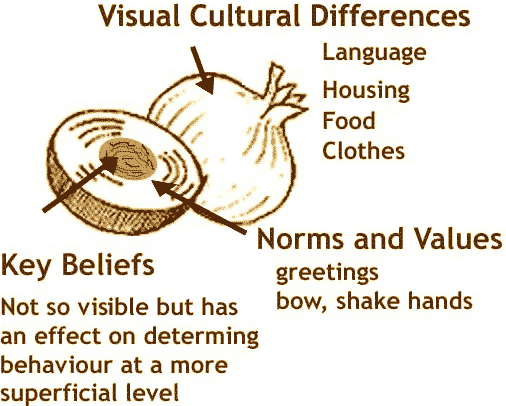
Culture,
understood as the accumulation of shared meanings, rituals, norms and
traditions among members of an organisation or society, is the collective
programming of the mind which distinguishes members of one group or society
from those of another.
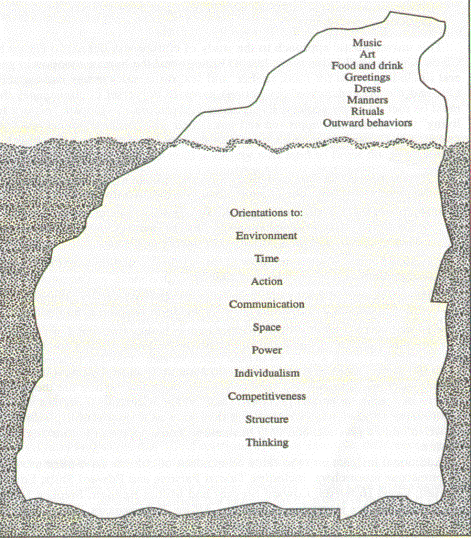
Therefore culture is not a phenomenon in its own right.
It is the difference perceived, and only then perceived, by one group when it
comes into contact with and observes another one. It is
important to point out that the idea of pure
cultures meeting in intercultural
exchanges without much knowledge about the other culture is outdated. Today
almost
everybody outside a given culture has some information and knowledge about that
culture, however
superficial.
CULTURE
AS AN ICEBERG
The foundation for most cross-cultural
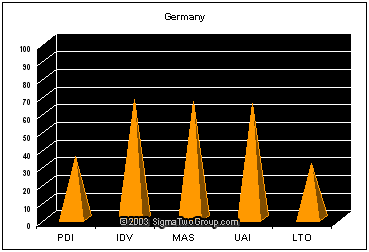
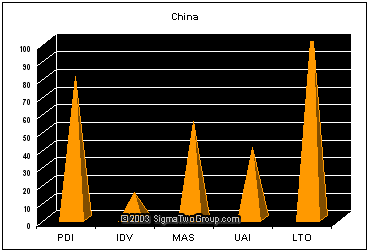
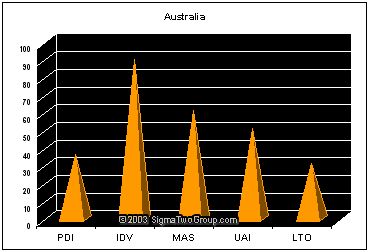
interpretation is the work of Geert Hofstede. He developed with the help of
large-scale samples starting in the 1970s cultural index scores for five
constructs:
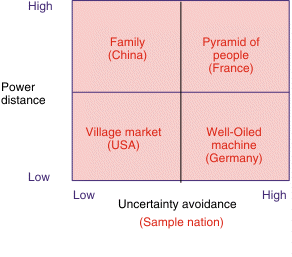
Power distance,
Uncertainty avoidance,
Individualism/Collectivism,
Masculinity/Feminity and
Long term/Short term orientation.
These dimension are
acquired through “mental programming”, learned patterns of thinking, feeling
and potential acting.
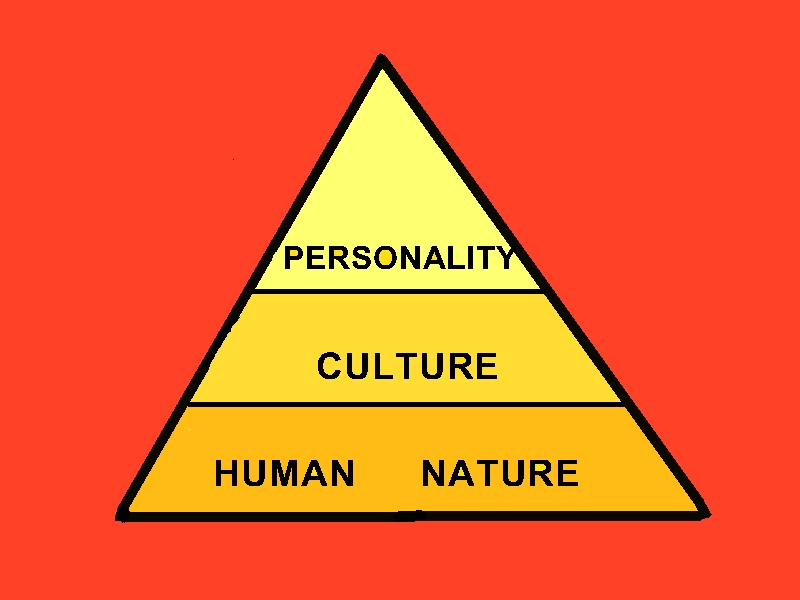
Three level of uniqueness are distinguished:
The
inherited universal human nature,
the learned culture specific to certain
societies or groups within a society, and
the inherited and learned individual
personality.
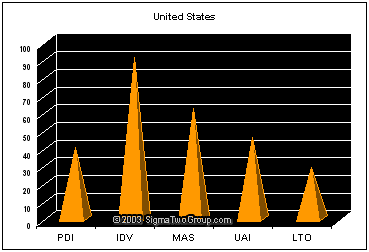
Hofstede’s five cultural dimensions
with scores for China, Japan, USA and Switzerland (lowest possible score 1,
highest possible score 118)
|
Dimensions
|
China
|
Japan
|
USA
|
Switzerland
|
|
(1) Power Distance. The extent to which
the less powerful members of a society accept and expect that power is
distributed unequally.
|
80
|
54
|
40
|
34
|
|
(2) Uncertainty Avoidance. The extent to
which a culture programs its members to feel either uncomfortable or
comfortable in unstructured situations and tries to control the
uncontrollable.
|
30
|
92
|
46
|
58
|
|
(3) Individualism is the degree to which
individuals are supposed to look after themselves or remain integrated into
groups (Collectivism).
|
20
|
46
|
91
|
68
|
|
(4) Masculinity refers to the
distribution of emotional roles between the genders, it opposes “tough”
masculinity to “tender” feminity.
|
66
|
95
|
62
|
70
|
|
(5) Long-term orientation refers to the
extent to which a culture programs its members to accept delayed
gratification of their material, social and emotional needs.
|
118
|
80
|
29
|
40
|
Consequences
Example:
|