|
Analysing Culture: Hofstede, Before and Beyond
Based on M/A Ch. 2+3 incl. Case Studies
“Culture is the collective programming of the human mind
that distinguishes the members of one human group from those of another.
Culture in this sense is a system of collectively held values.” -- Geert Hofstede
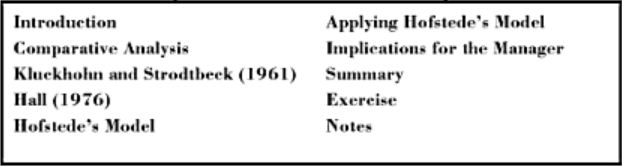

Kluckhohn & Strodtbeck: "Orientations"
Discuss the list on p. 31/32
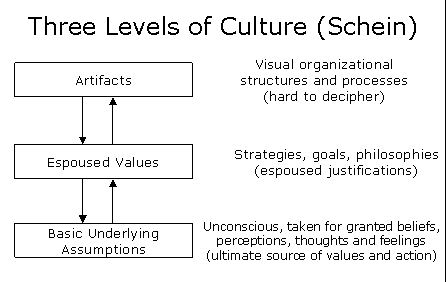
Usage: Edgar Schein:

Hall: High / Low Context
A popular cultural framework was
proposed by Edward Hall (1976, 2000), in which he stated that all cultures can
be situated in relation to one another through the styles in which they
communicate. In some cultures, such as those of Scandinavians, Germans, and the
Swiss, communication occurs predominantly through explicit statements in text
and speech, and they are thus categorized as Low-Context cultures. In other
cultures, such as the Japanese and Chinese, messages include other communicative
cues such as body language and the use of silence. Essentially, High-Context
communication involves implying a message through that which is not uttered.
This includes the situation, behavior, and para-verbal cues as integral parts of
the communicated message.
High context cultures are more common in the eastern
cultures than in western, and in countries with low racial diversity. Cultures
where the group is valued over the individual promote the in-groups and group
reliance that favor high context cultures. Co-cultures are also conducive to
high context situations, where the small group relies on their common background
to explain the situation, rather than words. A low context culture explains
things further, because those in a low context culture have a wide variety of
background.
High-Context and
Low-Context Cultures
High Context Cultures
Japan
China
Arab Countries
Greece
Spain
Italy
England
France
North America
Scandinavian Countries
German-speaking Countries
Low
Context Cultures
Source: Hall, E. and
M. Hall (1990)
Understanding Cultural
Differences |
High and Low Context within western
societies
The general terms "high context" and "low context" are used
to describe broad-brush cultural differences between societies.
High context refers to societies or groups where people
have close connections over a long period of time. Many aspects of cultural
behavior are not made explicit because most members know what to do and what to
think from years of interaction with each other. Your family is probably an
example of a high context environment.
Low context refers to societies where people tend to have
many connections but of shorter duration or for some specific reason. In these
societies, cultural behavior and beliefs may need to be spelled out explicitly
so that those coming into the cultural environment know how to behave.
High Context
- Less verbally explicit communication, less written/formal
information
- More internalized understandings of what is communicated
- Multiple cross-cutting ties and intersections with others
- Long term relationships
- Strong boundaries- who is accepted as belonging vs who is
considered an "outsider"
- Knowledge is situational, relational.
- Decisions and activities focus around personal
face-to-face relationships, often around a central person who has authority.
Examples:
Small religious congregations, a party with friends, family
gatherings, expensive gourmet restaurants and neighborhood restaurants with a
regular clientele, undergraduate on-campus friendships, regular pick-up games,
hosting a friend in your home overnight.
Low Context
- Rule oriented, people play by external rules
- More knowledge is codified, public, external, and
accessible.
- Sequencing, separation--of time, of space, of activities,
of relationships
- More interpersonal connections of shorter duration
- Knowledge is more often transferable
- Task-centered. Decisions and activities focus around what
needs to be done, division of responsibilities.
Examples:
large airports, a chain
supermarket, a cafeteria, a convenience store, sports where rules are clearly
laid out, a motel.
Ways that High and Low
Context Differ
- The Structure of Relationships
-
High:
Dense, intersecting networks and longterm relationships, strong
boundaries, relationship more important than task
-
Low:
Loose, wide networks, shorter term, compartmentalized relationships, task more
important than relationship
- Main Type of Cultural Knowledge
-
High:
More knowledge is below the waterline--implicit, patterns that are
not fully conscious, hard to explain even if you are a member of that culture
-
Low:
More knowledge is above the waterline--explicit, consciously
organized
-
|
| ARCHIVES
|
 |
The geography of thought: How culture colors the way the mind
works
ANN ARBOR, Mich.—Cultural differences in
the way the mind works may be greater than most people suspect,
according to University of Michigan psychologist Richard Nisbett,
author of "The Geography of Thought: How Asians and Westerners
Think Differently...and Why," just published by The Free
Press. "When you have a diverse group of people from different
cultures, you get not just different beliefs about the world, but
different ways of perceiving it and reasoning about it, each with
its own strengths and weaknesses," says Nisbett, a senior
research scientist at the U-M Institute for Social Research (ISR),
the world's largest academic survey and research organization.
 |
Westerners and East Asians describe this scene
in different ways
(Source: The University of Michigan Institute for Social Research) |
In the book, Nisbett, who also heads the U-M Culture
and Cognition Program, discusses the substantial differences in
East Asian and Western thought processes, citing experimental, historical,
and social evidence. His findings call into question the long-standing
psychological assumption that the way the human mind works is universal.
In the process, he addresses such questions as:
· Why did the ancient Chinese excel at algebra
and arithmetic, but not geometry?
· Why do Western infants learn nouns more
rapidly than verbs, when it is the other way around in East Asia?
· Why do East Asians find it so difficult
to disentangle an object from its surroundings?
"East Asian thought tends to be more holistic,"
says Nisbett, who also heads the U-M Culture and Cognition Program.
"Holistic approaches attend to the entire field, and make
relatively little use of categories and formal logic. They also
emphasize change, and they recognize contradiction and the need
for multiple perspectives, searching for the 'Middle Way'
between opposing propositions.
"Westerners are more analytic, paying attention
primarily to the object and the categories to which it belongs and
using rules, including formal logic, to explain and predict its
behavior."
In study after study described in the book, Nisbett
and colleagues from China, Korea, and Japan have found that East
Asians and Americans responded in qualitatively different ways to
the same stimulus situation. In one experiment, designed to test
whether East Asians are more likely to attend to the whole while
Westerners are more likely to focus on a particular object within
the whole, Japanese and Americans viewed the same animated underwater
scenes, then reported what they had seen.
"The first statement by Americans usually
referred to a large fish in the foreground," says Nisbett.
"They would say something like, 'There was what looked
like a trout swimming to the right.' The first statement by
Japanese usually referred to background elements: 'There was
a lake or a pond.' The Japanese made about 70 percent more
statements than Americans about background aspects of the environment,
and 100 percent more statements about relationships with inanimate
aspects of the environment, for example, that a big fish swam past
some gray seaweed."
In another experiment described in the book, Nisbett
and colleagues found that Americans respond to contradiction by
polarizing their beliefs whereas Chinese respond by moderating their
beliefs. In still another study, the researchers found that when
making predictions about how people in general could be expected
to behave in a given situation, Koreans were much more likely than
Americans to cite situational factors rather than personality characteristics
as reasons for someone's behavior.
Social practices and cognitive processes support
or "prime" one another, Nisbett points out. For example,
"the practice of feng shui for choosing building sites may
encourage the idea that the factors affecting outcomes are extraordinarily
complex," he notes, "which in turn encourages the search
for relationships in the field. This may be contrasted with the
more atomistic and rule-based approaches to problem-solving characteristic
of the West. Consider, for example, the nature of approaches to
self-help in the West: 'The Three Steps to a Comfortable Retirement'
or 'Six Ways to Increase Your Word Power.'"
|
|
Please form four groups and look at
the pictures below
of "Eva im Urlaub" 1-7.
Try to use your High Context skills
to find something out about these persons:
Character traits, situation,
hobbies, social status etc.
After the break please present your
findings.
|


 

Example: Conflict Management
Confrontation patterns:
Germany:
Voicing of existence of conflict,
exchange
of arguments,
attempt to find compromise,
attempt to find rule for
future conflict situation
(Cool - Hot - Cool)
East Asia:
Denying of existence of conflict,
stressing
of common ground,
use of third parties,
after establishment of winner:
lenience by winner or
without establishment of winner: abrupt stop of communication
(Friendly - more friendly
- friendly or break up)
"Shall we
dance?" Japan 1996 and Remake R. Gere, J. Lopez 2004)
http://www.imdb.com/video/screenplay/vi1652687129/
http://www.youtube.com/watch?v=bibtqDxXv1o
The film
tells the inspirational, yet often comical story of
Shohei Sugiyama (the great Koji Yakusho), a stoic,
middle-aged salaryman who seems to have everything
a guy could ask for: a house, a job, a loving wife,
and a wonderful daughter. But as Shohei slogs back
and forth from work, he begins to realize that there's
something missing in his life. It's something he can't
quite pinpoint, but it's there - and slowly, but surely,
it's eating away at his steely resolve.
Things start to get
interesting, however, on his commute home from work
when he notices a beautiful woman staring longingly
out of the window of the Kishikawa School of Dancing.
Each and every night he passes by the studio, looking
for her face and wondering what's troubling her. Then
one night, Shohei feels the inexplicable urge to flee
the train and meet this enigmatic woman. But little
does Shohei know that his newfound impulsiveness would
toss him right into the thick of the ultra-competitive
world of ballroom dancing!
Although Shohei does
actually get to meet Mai Kishikawa (Tamiya Kusakari),
the enigmatic woman at the window, she turns out to
be someone quite different than he expected, leaving
him (and the audience) cold thanks to her not-so-friendly
attitude.
By story's end, what
started out as a lark soon becomes something far more
important to Shohei. He falls in love, not with Mai,
but with the art of dancing. But when will he stop
keeping it a secret from his wife and include her
in this new passion that makes him so happy? The climactic
final act hinges on this question and provides a more
than suitable payoff for all that has come before.
|

 Print
Print