|
H 01
Strategic
Management:
Symptoms
Diagnosis
Treatment
What is Strategic
management - A summary at the end of the year
http://www.youtube.com/watch?v=JKY-3qUioPc
relevance of topic - Ask Mama Google
Image:
Books, Processes, Models, Pyramids
strategic
management in tourism
Additional issues in Tourism: many
stakeholders, use of public space, strong international competition,
production at same time of consumption, subjective quality criteria
Typical curriculum:
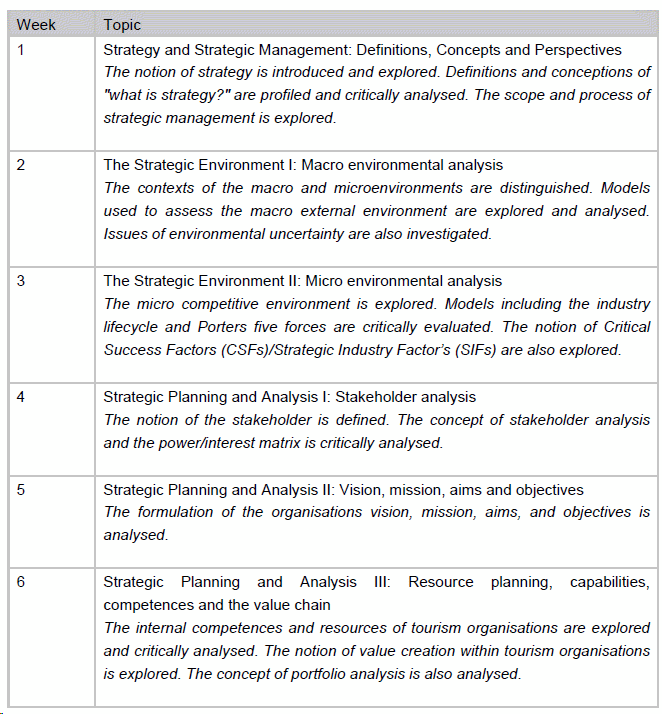
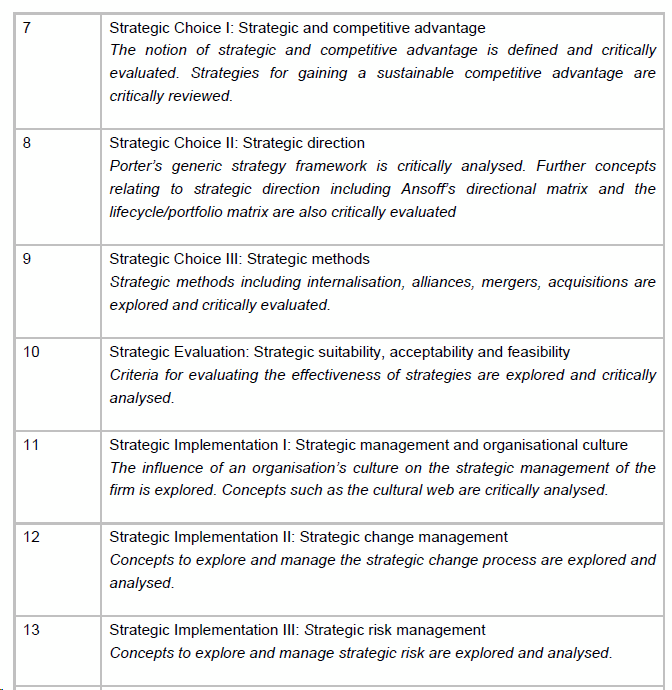

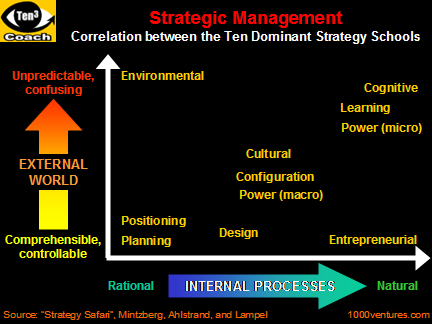
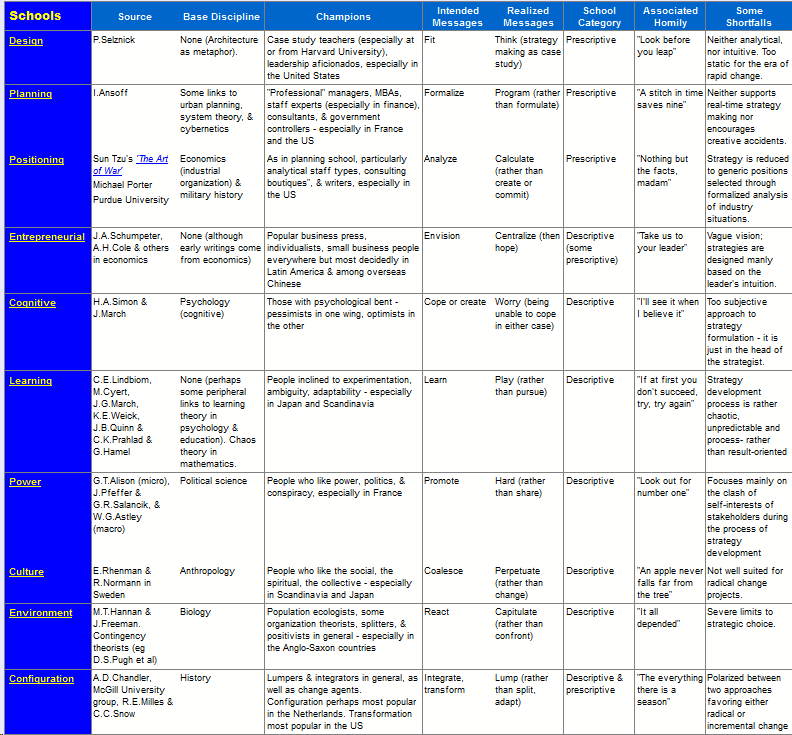
Ten major thinking schools
http://www.1000ventures.com/business_guide/mgmt_inex_stategy_10schools.html
The Design School
The original view sees strategy formation as achieving the
essential fit between internal strengths and weaknesses and external threats and
opportunities (see SWOT
analysis). Senior management formulates clear and simple strategies in a
deliberate process of conscious thought - which is neither formally analytical
nor informally intuitive - and communicates them to the staff so that everyone
can implement the strategies. This was the dominant view of the strategy process
at least into the 1970s given its implicit influence on most teaching and
practice.
The Planning School
This school grew in parallel with the design school. But the
planning school predominated by the mid-1970's and though it faltered in the
1980's it continues to be an important influence today. The planning school
reflects most of the design school's assumptions except a rather significant
one: that the process was not just cerebral but formal, decomposable into
distinct steps, delineated by checklists, and supported by techniques
(especially with regard to objectives, budgets, programs, and operating plans).
This meant that staff planners replaced senior managers, de facto, as the key
players in the process. Today, many companies get little value from their annual
strategic-planning process. To meet the new challenges, this process
should be redesigned to support real-time strategy making and to encourage
'creative accidents'.
The Positioning School
This prescriptive school was the dominant view of strategy
formulation in the 1980's. It was given impetus especially by Harvard professor
Michael Porter in 1980, following earlier work on strategic positioning in
academe and in consulting, all preceded by a long literature on military
strategy, dating back to 500 BC and that of Sun Tzu, author of
The Art of War.
In this view, strategy reduces to generic positions selected through formalized
analysis of industry situations. Hence, planners became analysts. This
proved especially lucrative to consultants and academics alike, who could sink
their teeth into hard data and so promote their "scientific truths" to companies
and journals alike. This literature grew in all directions to include strategic
groups, value chains,
game theories, and
other ideas - but always with this analytical bent.
The Entrepreneurial
School
Much like the design school, the entrepreneurial
school centered the process on the chief executive, but unlike the design
school, and in contrast to the planning school, it rooted that process in the
mysteries of intuition. That shifted the strategies from precise designs, plans,
or positions to vague visions, or perspectives, typically to be seen through
metaphor. The idea was applied to particular contexts –
start-ups, niche players, privately owned companies and "turnaround"
situations, although the case was certainly put forward that every organization
needs the discernment of a visionary
leader,
The Cognitive School
On the academic front, there was interest in the origin of
strategies. If strategies developed in people's mind as frames, models, or maps,
what could be understood about those mental processes? Particularly in the
1980's, and continuing today, research has grown steadily on cognitive biases in
strategy making and on cognition as information processing. Meanwhile, another,
newer branch of this school adopted a more subjective interpretative or
constructivist view of the strategy process: that cognition is used to construct
strategies as creative interpretations, rather than simply to map reality in
some more or less objective way.
The Learning School
Of all the described schools, the learning school became a
veritable wave and challenged the omnipresent prescriptive schools. Dating back
to early work on "incrementalism",
as well as conceptions like "venturing",
"emerging strategy", (or the growing out of individual decisions rather than
being immaculately conceived) and "retrospective sense making", (that we act in
order to think as much as we think in order to act), a model of strategy making
as a learning developed that different from the earlier schools. In this view,
strategies are emergent, strategists can be found throughout the organization,
and so-called formulation and implementation intertwine.
The Power School
This comparatively small, but quite different school has focused
on strategy making rooted in power, in two senses. Micro power sees the
development of strategies within the organization as essentially political, a
process involving bargaining, persuasion, and confrontation among inside actors.
Macro power takes the organization as an entity that uses its power over others
and among its partners in
alliances,
joint ventures, and other network relationships to
negotiate "collective" strategies in its interests.
The Cultural School
As opposite to the power school that focuses on self-interest and
fragmentation, the cultural school focuses on common interest and integration.
Strategy formation is viewed as a social process rooted in
culture. The theory
concentrates on the influence of culture in discouraging significant strategic
change. Culture became a big issue in the United States and Europe after the
impact of Japanese management (see Kaizen
and Competitive Advantage: US
versus Japan) was fully realized in the 1980's and it became clear
that strategic advantage can be the product of unique and difficult-to-imitate
cultural factors.
The Environmental
School
Perhaps not strictly strategic management, if one takes that term
as concerned with how organizations use their degrees of freedom to create
strategy, the environmental school nevertheless deserves attention for the light
it throws on the demands of the environment. Among its most noticeable theories
is the "contingency theory", that considers what responses are expected of
organizations that face particular environmental conditions, and "population
ecology", writings that claim severe limits to strategic choice.
The Configuration
School
This school enjoys the most extensive and integrative literature
and practice at present. One side of this school, more academic and descriptive,
sees organization as configuration - coherent clusters of characteristics and
behaviors - and so serves as one way to integrate the claims of the other
schools: each configuration, in effect, in its own place, planning for example,
in machine-type organizations under conditions of relative stability,
entrepreneurship under more dynamic configurations of start-up and turnaround.
But if organizations can be described by such states, then change must be
described as rather dramatic transformation - the leap from one state to
another. And so, a literature and practice of transformation - more prescriptive
and practitioner oriented (and consultant promoted) – developed as the other
side of the coin. These two very different literatures and practices
nevertheless complement one another and so belong to the same school.
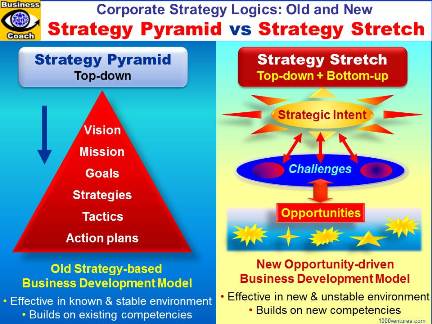
Think of growing your business as growing a perfect human
being – in all his or her complexity and integrity. Think of this human
being as a multi-skilled sportsman who is to win various competitions, both
individually - a 100 m sprint run, a tennis tournament, and a chess match – and as a team player
– a relay-race, safari rally, and football. He is also
to live a harmonious family, social and cultural life, grow his children and
support his elders... Clearly, narrow strategies aimed at perfecting
different functions of this person – body-building, thinking-building, or
personality-building – would not create a perfect man. The same
is also correct for the business strategy development in the new era of
systemic innovation where good in parts is no good at all.
The old linear and static approaches might work well for the old era of
slow, linear and incremental change. The
emerging era of
rapid, systemic and radical change requires more flexible, systemic and
dynamic approaches to strategy formulation.
Thus today, corporate strategy formulation should be a combination of
different currently practiced approaches described above – judgmental
designing, intuitive visioning, and emergent learning; it should be about
transformation as well as perpetuation; it has to involve individual
cognition and social interaction, co-operative as well as conflictive; it
must include analyzing before and programming after as well as negotiating
during; and all of this must be in response to what can be a demanding
environment.
Certain positive moves in this direction have been seen
recently. Some of the more recent approaches to strategy formulation take a
wider perspective and cut across the above ten schools in eclectic and
interesting ways, for example Learning and Design in the "Dynamic
Capabilities" approach, or the "Dynamic Strategy" one based on knowledge
working.
How to get
bankrupt:
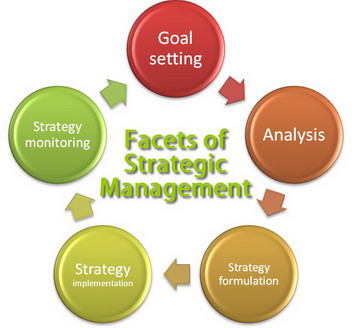
Five facets of Strategic ManagementStrategic management
comprises five key facets: goal-setting, analysis, strategy formation,
strategy implementation, and strategy monitoring. These are the integral
elements that, when applied together, distinguish strategic management
from less comprehensive approaches, such as operational management or
long-term planning. Strategic management is an iterative, continuous
process that involves important interactions and feedback among the five
key facets.
http://www.dineshbakshi.com/as-a-level-business-studies/strategic-management/108-revision-notes/1378-five-facets-of-strategic-management
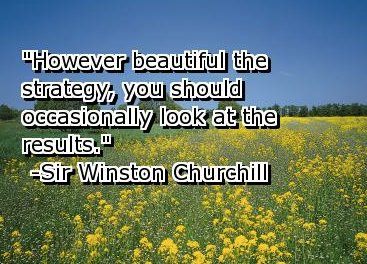
How much
does Strategic Management cost
- if you
do an annual / monthly / daily review?
Symptoms
Diagnosis
Treatment
Symptoms:
- Trying to make the unplanable planable
- Being weak
on values and long-term perspective, strong on annual budgets
-
Spending a lot of money and management time on careful planning
Diagnosis:
-
Behaviour left over from industrial (19th/20th) slow-moving, few
players economic situation
-
Hindering innovation
-
Slowing down reaction time to adopt to changing situation
-
Transferred from industrial production to service provision
Treatment:
Example:
New York
City Tourism Development Council 2000:
Development of Inbound
Tourism Strategy 2015
Example
Blog China Daily:
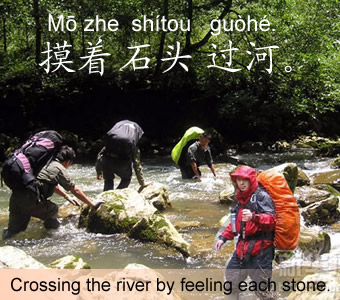
China's top leader, Xi Jinping, quoted Deng's adage to feel
the stones
while crossing the river as a model for China's development.
Learning from pilot studies, and constant monitoring for both gains and
losses of every policy implementation, making adjustments constantly and
regularly, is the key to success of all complex systems, embedded in
thousands of feedback systems in mechanics, electronics, optics,
transportantion and weapons systems.
Using a single theory to explain everything, and then closing one's eyes
while implementing it, is far more risky and far more prone to failure
than doing things with both eyes open and both ears listeining, but more
importantly, with both hands and both feet firmly in touch with
reality.
|