|
|
Best viewed with Internet Explorer.
(6) Page 2
Maslow's Pyramid
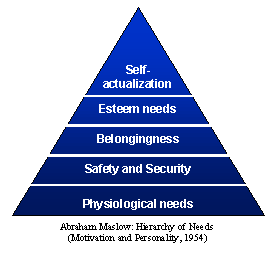


In the 1950s Maslow set up a hierarchical theory
of needs in which all the basic needs are at the bottom, and the needs concerned
with man's highest potential are at the top. The hierarchic theory is often
represented as a pyramid, with the larger, lower levels representing the lower
needs, and the upper point representing the need for self-actualization. Each
level of the pyramid is dependent on the previous level. For example, a person
does not feel the second need until the demands of the first have been
satisfied.
- Biological / Physiological
Needs. These needs are biological and consists of the needs for oxygen,
food, water, and a relatively constant body temperature. These needs are the
strongest because if deprived, the person would die.
- Security / Safety Needs.
Except in times of emergency or periods of disorganization in the social
structure (such as widespread rioting) adults do not experience their security
needs. Children, however often display signs of insecurity and their need to be
safe.
- Social (Love, Affection and
Belongingness) Needs. People have needs to escape feelings of loneliness and
alienation and give (and receive) love, affection and the sense of
belonging.
- Ego / Esteem Needs. People
need a stable, firmly based, high level of self-respect, and respect from others
in order to feel satisfied, self confident and valuable. If these needs are not
met, the person feels inferior, weak, helpless and worthless.
- Self-actualization
Fulfillment. Maslow describes self-actualization as an ongoing process.
-
|
Maslow's
ideas are still influencing today's
business practice, but have been heavily
critisised.
What are the weak points
in his theory?
|
Whose Knowledge Is It?
By Linda Peterat and Richard Fairbanks
Who can tell me what are people's most basic needs? asked the teacher.
"Food, shelter, clothing," were the students' replies. Ming, one of
the more quiet boys at the back table raised his hand, "I put family
because if you have family, you always have food." "No," said
the teacher elaborating on the students' earlier answers, "the most basic
needs are physiological—food, shelter, and clothing." This student-teacher
interaction was part of a family living lesson which included an introduction
to human needs and values by considering Maslow's hierarchy of needs. Maslow's
hierarchy is often a part of discussion in grade eight lessons on basic human
needs and wants. It is often a lesson component in foods and nutrition,
clothing and textiles, housing, and family relations. This hierarchy is often
contained in family studies texts and is even present, in many home economics
curriculum guides (see Ministry of Education, 1992, p.23)
Those concerned with gender inequities recognize that some
"theories" such as Maslow's are limited in the extent to which they
can be generalized to all people and may be biased depending on the particular
interests and experiences of the person who develops the theory. Critical and
feminist theorists propose that all ideas that are passed on to others as
"knowledge" should be interrogated and questioned in terms of
"Whose knowledge is this?" They go further in claiming that much
knowledge perpetuated in educational institutions is partial and biased. Thus,
we can ask, "Whose theory is this?" and, "ln whose interest is
it?"
If we recall Maslow's theory of human development, it suggests that
basic needs are physiological and the ultimate at the top of the pyramid model
is self actualization, implying an unattached human being realizing full
potential and autonomy. Maslow's theory is one example of human development
theories that have dominated psychological theorizing. Other theorists such as
Erickson, Freud, and Piaget are common in home economics texts and courses as
well. In recent years women psychologists have examined why it is that men's
theories have been dominant. Walsh (1992) reviews historical analyses that show
that early in the twentieth century, women psychological researchers were
marginalized in the university and research communities, and their research
ignored. Others argue that male researchers have ignored women's experiences by
basing their research only on men/boys, then generalizing that research to all
people (women and men).
Shakeshaft and Nowell (1984) criticize Maslow's theory for being based
on traditional male values which place self-esteem and self-actualization needs
on higher planes than affiliation needs. Theories such as Maslow's,
contribute to inequities when they become a dominant view posing as truth or
portraying reality when alternate theories and critiques of theories are
disregarded. Such a treatment of theories can contribute to cultural as well as
gender inequities. A white, western male viewpoint evidenced in many psycho
social theories cannot help us understand other cultures. For instance, Maslow
and Kohlberg may not help us to understand Asian, Indian, and First Nations'
values regarding moral decision making or hierarchy of needs. Any differences
between or within cultures are silenced by considering only one view. When one
view dominates, people's experiences that do not fit the model are silenced.
"Critical social science has been roundly critical of Maslow's discourse on needs
(Knights and Willmott, 1974/5; Cullen, 1994;1997; Townley,1995). The key
points here are that Maslow's hierarchy of needs lack of appreciation of
identity as a relational production and the political processes engaged in such
a production (Cruikshank, 1993). While Maslow himself was circumspect on such
issues, the implications and extension of his work seemingly supports a liberal
political position and the reading of economic, social and political issues as
problems of personal growth.
For example ‘the problem’ with a particular group
of workers - women for example (Wilson, 1995) - is not their common political
history of domination or exploitation, but rather 'low self esteem’. And in work
organizations the problem of particular people (recalcitrant professionals for
instance) is not intimidating and authoritarian management practice, but an
assumed lack of drive to satisfy intrinsic needs for self-actualisation and
esteem." (Craig, Pritchard
2001)

Contact: wolfgang.arlt@fh-stralsund.de
Office: 1/132, Tel. (03831) 45 6961
|
|

