|
TOURISM AND POLITICS
IN ASIA AND AFRICA
‘When the tourists flew in’ by
Cecil Rajendra Bones and
Feathers (Hong Kong: Heinemann 1978)
The Finance Minister said
“It
will boost the economy,
the dollars will flow in.”
The Minister of Interior said
"It
will provide full
and varied employment
for all the indigenes."
The Minister of Culture said
“It
will enrich our life...
contact with other cultures
must surely
improve the texture of living.”
The man from the Hilton said
“We
will make you a second Paradise;
for you it is the dawn
of
a glorious new beginning!”
When the tourists flew in
our island people
metamorphosed
into a grotesque
carnival
- a two-week
sideshow
When the tourists flew
in
our men put aside their fishing
nets
to become waiters
our women became
whores
When the tourists flew
in
what culture we had went out the
window
we traded our customs
for sunglasses and
pop
we turned sacred
ceremonies
into ten-cent peep
shows
When the tourists flew
in
local food became
scarce
prices went up
but our wages stayed
low
When the tourists flew
in
we could no longer
go down to our
beaches
the hotel manager
said
'Natives defile the
sea-shore'
When the tourists flew
in
the hunger and
squalor
were preserved
as a passing pageant
for clicking cameras
- a chic eye
sore!
When the tourists flew
in
we were asked
to be 'side-walk
ambassadors'
to stay smiling and
polite
to always guide
the 'lost' visitor...
Hell, if we could only tell them
where we really want them to go!
Remember from last semester? - Updated version
|
Six
approaches to Tourism Planning and Policies, their assumptions and main questions:
>
boosterism:
"Tourism
is good"
How to attract tourists,
how to make locals into good hosts.
>
economic, industry-oriented approach:
"Tourism
is an industry like other industries"
How
to maximize profit, cost-benefit analysis
>
physical/spatial approach:
"Tourism
is a resource user"
Visitor management,
carrying capacity, environmental impact,
National Parks
>
community-oriented approach:
"Tourism
changes local societies"
Empowerment,
education, social impact
>
sustainable approach:
"Tourism
needs holistic approach"
Tourism
as system, tourism planning part of overall
planning, stakeholder
>
responsible approach:
"Responsible Tourism gives equal weight to the economy,
society and the environment – the three pillars of sustainable
development."
Tourism
not only as a threat to but also as an opportunity
for development
(after Getz 1987/Hall
2000, UNWTO 2007)
|
Tourism in most Asian
and African countries went through these stages in a few decades,
mostly starting after gaining independence (1960s).
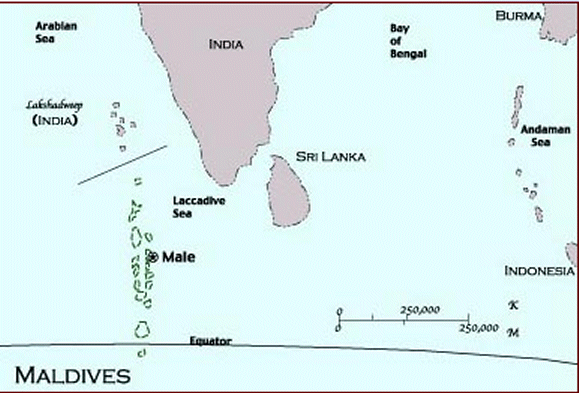
Example:
Maldives
Independence from British rule 1965
UN experts saying "Maldives not fit for tourism development"
1972 first resort
direct flights since 1980s
1980 40,000 visitors (11,000 Germans)
1986 tourism
main foreign exchange earner, 110,000 visitors (30,000 Germans)
1989: Maximum no. of tourists according to government: 160,000,
avoidance of "pollution" of Islamic culture by tourism
2000: 470,000 visitors (of which 170,000 Italians and Germans)
2004: 616,000 visitors, after Tsunami reduction in 2005, back
to 602,000 in 2006
300,000
inhabitants, 300 qkm Rügen
1,000 qkm
TOURISM
YEARBOOK MALDIVES 2007
Economic development but
no political progress:
President still the same as elected
1965
Feudal islamic structures remain intact
Coup attempts in 1980, 1983, 1988 (1988 intervention by Indian
paratroopers)
"Cold civil war" since 2004, fighting
in 2004, 2005, 2006 including Tourism Ministry
Tourism
development mostly undisrupted
Tourism development policy goals different
from Europeans:
- Nation Building
Example
Japan
Example
China:
"Another important basic force supporting
the increase of domestic tourism in China can be found in the production
of the imagined community China. Following Benedict Anderson’s (1991;
1998) classical analysis of nationalism as a form shaped by a collective
imagining enabled by modern technology, the People’s Republic of
China and their citizens had to invent themselves again after 1978
as a nation based on a thousands of years of history. The end of
the official Maoist rejection of the cultural past and the attempt
to replace it with a new Chinese socialist culture as well as the
end of the reduction of nature to a tool for production alone gave
rise to the need of the reassessment of the Chineseness of China.
In 1982, the National Heritage Conservation
Act ‘provided the foundation for tourism to embrace heritage in
its development’ (Sofield, Li 1998a:371). Not only could foreign
tourists visit the highlights of the achievements of Chinese civilization,
but also overseas and domestic tourists could see with their own
eyes and relate to what they were proud of as part of their national
– or, in the case of overseas Chinese, transnational – identity.
‘The conservation and presentation of traditional culture were
also approved because of its perceived contribution to enhance national
unity and to develop the country’s tourism product’ (Sofield, Li
1998a: 363). In the same year, the CNTA Director Han Kehua announced
that China would employ in future a ‘Chinese’ architectural style
for the construction of hotels and restaurants (Han 1982; Gee 1983),
newly embracing heritage also for the tourism infrastructure.
.. Beside the obvious attributes of nations, such as the national
flag, anthem, border or frontiers, hidden aspects, such as national
recreations, the countryside, popular heroes and heroines and fairy
tales, all connected to touristical experiences, are shared by the
members of a community (Smith 1991). They act as signifiers of the
nation as a community with common beliefs, an historic homeland
and as a common culture. This common culture was strengthened during
the course of the modernization of China by stronger economic relations
between the provinces of China, the spreading of Putonghua as standard
Chinese language through schooling and television, improvements
in transport infrastructure, etc. By travelling throughout China
– or at least to the next bigger city – domestic tourists reinforce
the imagined community spatially. ‘Tourism plays a vital part in
both the “imagining” – i.e. bringing into awareness – and the “re-creation”
of national cultures in Asia and Oceania’ (Graburn 1997: 201)."
(Arlt 2006: 90-92)
|