|
International
Human Resource
Management
Personal
Experiences in HRM Labour markets
Recruitment
and selection
After looking at some basics of HRM in Leisure
& Tourism, in this session we want to sample the practical experiences
of the participants.
What have been your best and worst experiences with HRM?
How
do they fit with the "Best fit" and "Best practice"
approaches we have discussed earlier?
Best fit
|
Mass Service
Example: Marriott
High labour intensity
Low customization
|
Professional Service
Example:
Abercrombie & Kent
High labour intensity
High customization
|
|
Service Factory
Example:
McDonalds
Low labour intensity
Low customization
|
Service Shop
Example: Subway
Low labour intensity
High customization
|
Best practice
Beside the "Best Fit" paradigm there also exists the "Best practice"
paradigm, which claims that there are good practices which are important for all
companies, including
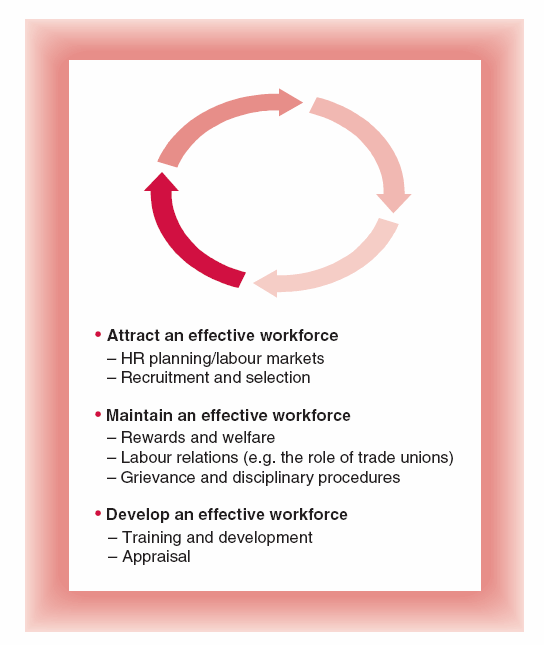
● Recruitment and selection: Recruiting and selecting staff with the correct
attitudinal and behavioural characteristics. A range of assessments in the
selection process should be utilized to evaluate the work values, personality,
interpersonal skills and problem-solving abilities of potential employees to
assess their ‘service orientation’.
● Retention: The need to avoid the development of a ‘turnover culture’, which
may of course be particularly prevalent in tourism and hospitality. For example,
the use of
‘retention bonuses’ to influence employees to stay.
● Teamwork: The use of semi-autonomous, cross-process and multi-functional
teams.
● Training and development: The need to equip operative level staff with team
working and interpersonal skills to develop their ‘service orientation’ and
managers with a new leadership style which encourages a move to a more
facilitative and coaching style of managing.
● Appraisal: Moving away from traditional top down approaches to appraisal
and supporting things such as customer evaluation, peer review, team-based
performance and the appraisal of managers by subordinates. Generally, all of
these performance appraisal systems should focus on the quality goals of the
organization and the behaviours of employees needed to sustain these.
● Rewarding quality: A need for a much more creative system of rewards and in
particular the need to payment systems that reward employees for attaining
quality goals.
● Job security: Promises of job security are seen as an essential component
of any overall quality approach.
● Employee involvement and employee relations: By seeking greater involvement
from employees the emphasis is on offering autonomy, creativity, co-operation
and self-control in work processes. The use of educative and participative
mechanisms, such as team briefings and quality circles are allied to changes in
the organization of work which support an
‘empowered’ environment.
|