|
International
Human Resource
Management
Recruitment
and selection
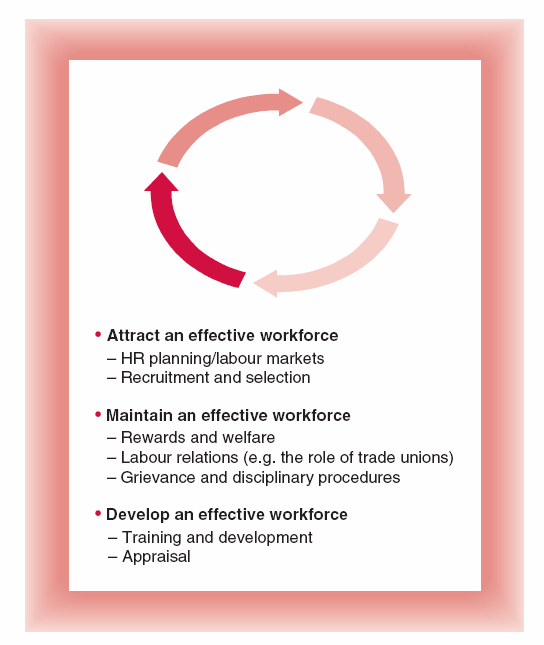
Best practice
● Recruitment and selection: Recruiting and selecting staff with the correct
attitudinal and behavioural characteristics. A range of assessments in the
selection process should be utilized to evaluate the work values, personality,
interpersonal skills and problem-solving abilities of potential employees to
assess their ‘service orientation’.
Definition:
"The process of generating a pool of candidates from which
to select the appropriate person to fill a job vacancy" (Heery/Noon
2002).
- Job analysis
- Job description
- Person specification / competency profile in the recruitment
context
Traditional specification model (Rodger 1952):
* Physical characteristics
* Attainments - qualifications
* General intelligence
* Special aptitudes
* Interests (work related / leisure related)
* Disposition ("character")
* Circumstances
Service economy: Paradigm (master narrative) shift from
"What
can he/she do" --> "What is he/she like"
- "right" attitude
- "right" appearance
- look good/appropriate, sound right
Soft skills become more important than technical skills
Example Scottish boutique hotel: 10 days training for new staff
members including how to style hair/make-up, learning to look "successful"
/ "confident".
Where and how you look for your new staff members influence which
kind of people you attract:
- Media used (local paper, trade paper, national paper, internet)
- Image developed (website, WOM)
- Form and content of job offer information
- trials, internships, step-by-step integration (examples: Ruf,
Thomas Cook, TUI aqtiv)
|