|
Fr
11.45-15.30 h S 04
4 SWS Course International Management and Culture
Workload: 60 h classroom work / 180 h self-study
ECTS points: 8
Examination: Presentations (25%), Assignment paper (12-15 pages p.P.) (75%)
Course organisation:
Lecture (before lunch):
Chapters Mead/Andrews (2009) International Management Culture
30 min. presentation by a student, discussion
chaired by student (20% mark)
(Additional input / case studies Arlt)
Hardcopies of relevant chapters to be read by all participants before.
(Part of the book is on Google books)
http://books.google.de/books?id=s7_CfAYH_7UC&printsec=frontcover&dq=mead+andrews+international+management&hl=de&ei=2ZWtTPyjDsvU4waRh6ilBg&sa
=X&oi=book_result&ct=result&resnum=1&ved=0CDYQ6AEwAA#v=onepage&q&f=false
Seminar (after lunch):
One topical book about Intercultural Management presented and
discussed by a student:
Synopsis paper (2-3 pages) handed out to participants one week before presentation
30 min.
presentation, 60 min. structured discussion (included an active part for
participants:
for instance every participant has to tell an experience related
to the topic; prepared role play or debate etc.)
(Presentation+Synopsis 30% mark)
15 pages
assignment paper to be handed in by January 31 (50% mark)
Books to choose from:
Nakata: Beyond Hofstede (2 parts)
Graburn: Multiculturalism in New Japan
Bauman: Culture and Liquid Modernity
Morgan: Cross-Cultural Ethics
Dressler: Asian HRM
Bloch/Whiteley: The Global You
Hall/Hall: Understanding Cultural Differences (Germany, France, USA)
Robinowitz/Carr: Modern-Day Vikings (Sweden)
Yamada: Different Games - Different Rules (Japan)
During second session please provide a first impression of the book you choose
(which means: have a look at the book between now and next week! and bring it to the session!)
PS.: This is part of the mark for the seminar part.
All information given in this lecture is available here (www.arlt-lectures.com) for download.
Please check the homepage of the website regularly for announcements about time changes etc.
|
14.10.
|
Introduction
|
- |
|
21.10.
|
Introduction International Management and Culture based on M/A Ch. 1 (Arlt)
Student assignments: First feedback on topical books, Q&A
|
Arlt |
| |
|
28.10.
|
Analysing Culture Hofstede, Before and Beyond based on M/A Ch. 2
Yamada: Different Games - Different Rules (Japan)
|
|
| |
|
4.11.
|
Analysing Culture Hofstede, Before and Beyond based on M/A Ch. 3
Graburn: Multiculturalism in New Japan
|
|
| |
|
11.11.
|
Nakata: Beyond Hofstede (part 1)
Nakata: Beyond Hofstede (part 2)
|
|
| |
|
18.11.
|
Changes in Culture based on M/A Ch. 4
Bauman: Culture and Liquid Modernity
|
|
| |
|
25.11.
|
Organisational Culture based on M/A Ch. 5
Robinowitz/Carr: Modern-Day Vikings (Sweden)
|
|
| |
|
2.12.
|
Culture and Communication based on M/A Ch. 6
Bloch/Whiteley: The Global You
|
|
| |
|
9.12.
|
E-communication based on M/A Ch. 16
Morgan: Cross-Cultural Ethics
|
|
| |
|
16.12.
|
HRM based on M/A Ch. 19
Dressler: Asian HRM
|
|
| |
|
23.12.
|
Convergence and Divergence based on M/A Ch. 22
Hall/Hall: Understanding Cultural Differences (Germany, France, USA)
|
|
| |
| Christmas break |
|
|
|
13.1. |
Forecast: Management and Culture in the second decade of the 21st century
|
- |
|
20.1.
|
Summing up and Feedback
|
- |
|
|
|
|
|
|
|
|
| |
|
|
| |
|
|
Introduction Intercultural Management - Multicultural Management - Diversity Management
International Management in a globalized world is faced with the task of successful "Diversity Management". It has to take into account
that no longer simple "intercultural" concepts are working, as almost no country
has a "pure" national culture without strong outside influences, as more and
more staff members, customers, business partners are not rooted in just one
culture. Still, management without careful tuning to cultural influences is
bound to fail.
Do you agree? What are your experiences with "intercultural" encounters while working or studying (or travelling)?
First definition:
“Culture is the collective programming of the human mind
that distinguishes the members of one human group from those of another.
Culture in this sense is a system of collectively held values.” -- Geert Hofstede
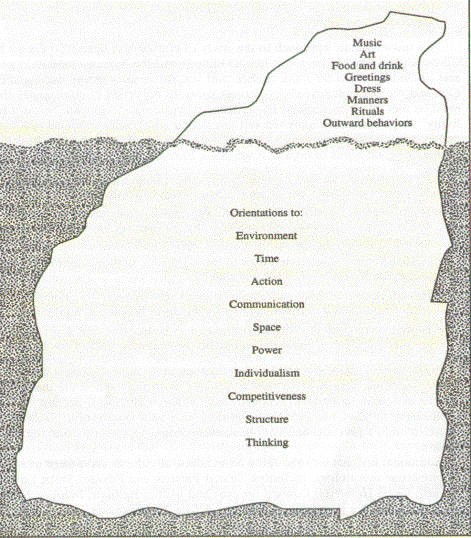
CULTURE AS AN ICEBERG
|
Many intercultural trainings concentrate on the "Do's and Don'ts" of different
cultures:
- Give and receive a namecard to a
Chinese persons always with both hands
- Avoid the number 13 in western
countries
- Do not give knifes or scissors as
a present in China
- Do not slap a German person on
the shoulder as a greeting
- Do not give money as a gift in
Bulgaria ... etc.
Two arguments against such superficial approaches:
a) For an internationally active
manager, it is impossible to know the "Do's and Don'ts" of all cultures and
sub-cultures (always use a 100 US$ bill when snorting cocaine at a Manhattan
party...) in the world.
b) Reducing the cultural differences
to "above the sea-level" features will not help you to understand the underlying
differences and will not help you to understand the relativeness of your
own
cultural behaviour.
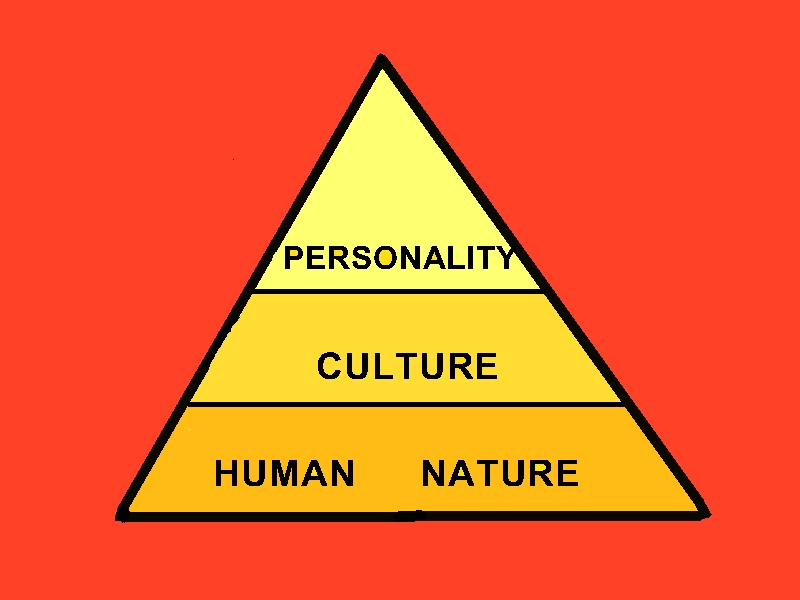
Culture is - according to Hofstede -
acquired through “mental programming”, learned patterns of thinking, feeling and potential acting.
Three level of uniqueness are distinguished:
- The inherited universal human nature,
- the learned culture specific to certain societies or groups within a society, and
- the inherited and learned individual personality.
Example: Language
Let us try to understand the "Why?"
behind some different behaviours and customs for some typical
occurences:
Examples
- telling the truth / being
polite
- punctuality /
flexibility
- quoting sources / following
mainstream
- learning from theories / learning
from examples
Please form three groups (if possible mixture of native Germans and others) and develop
a list of 7 Do's and 7 Don't for Germany and for another country
of your choice. Try to analyse the cultural reasons behind the behaviour using
your background knowledge (including Hofstede).
After 20 minutes each group should present the lists
and the explanations.
|
|
|
|
|